

AI is transforming how law firms handle medical records in personal injury cases. By automating the review process, AI reduces time spent on tedious tasks, improves accuracy, and identifies critical details that might be missed during manual reviews. Here’s what you need to know:
- Why it matters: Medical records are key to proving injuries, linking them to accidents, and calculating damages. AI tools help law firms demand settlements that are 20–30% higher by uncovering more comprehensive injury details.
- Major challenges: Manual reviews are slow, expensive, and prone to errors. Reviewing 1,000 pages can take weeks and cost up to $4,500 in paralegal time.
- How AI helps: AI processes thousands of pages in hours, creates organized timelines, and uses technologies like NLP and OCR to extract and summarize relevant information.
- Key features: AI tools provide hyperlinked citations, separate pre-existing conditions from new injuries, and highlight gaps in treatment – making case preparation more efficient.
- Results: Firms using AI report saving 8+ hours per case, increasing settlement demands, and improving case outcomes.
AI isn’t replacing human expertise but is a powerful tool to streamline workflows, save time, and improve case quality. With proper oversight, it changes how attorneys evaluate and present medical evidence.
How AI Summarizes Medical Records
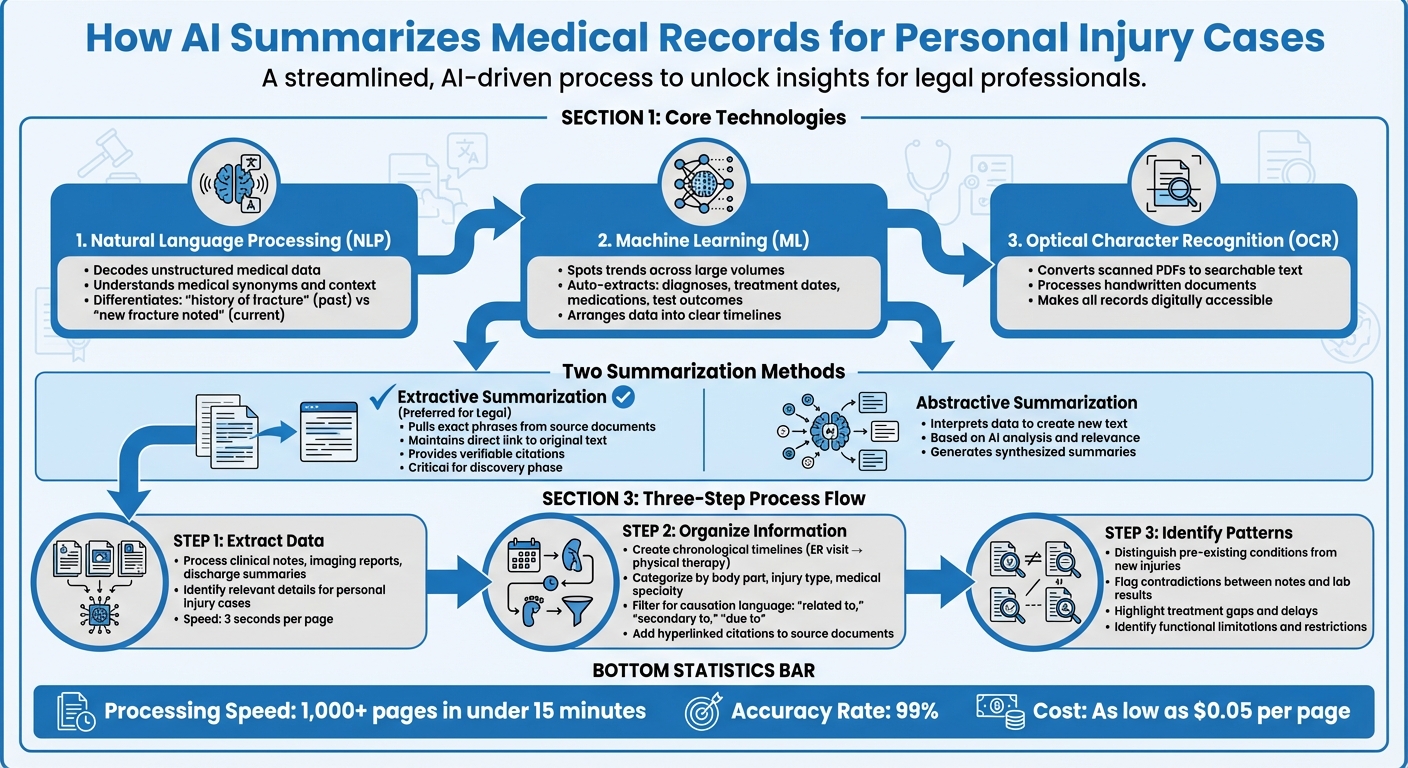
AI Medical Record Summarization Process for Personal Injury Cases
AI transforms detailed medical records into structured, easy-to-read summaries using Natural Language Processing (NLP) and Machine Learning (ML). These tools sift through clinical notes, imaging reports, and discharge summaries to pinpoint the most relevant details for personal injury cases. The process typically involves three key steps: extracting data, organizing it, and recognizing patterns.
Core Technologies: Natural Language Processing and Machine Learning
NLP allows AI to decode unstructured medical data, such as handwritten notes and scanned documents. By understanding medical synonyms and context, it can differentiate between phrases like "history of fracture" (indicating a past condition) and "new fracture noted" (indicating a recent injury).
Machine Learning takes this a step further by spotting trends across large volumes of medical records. These models are trained to automatically extract critical information – like diagnoses, treatment dates, medications, and test outcomes – and arrange it into a clear timeline. Additionally, Optical Character Recognition (OCR) technology enables AI to convert scanned PDFs and handwritten documents into searchable text.
AI summarization operates in two primary ways:
- Extractive summarization: This method pulls exact phrases and data points directly from the source document, maintaining a direct link to the original text.
- Abstractive summarization: This method interprets the data to create new text based on its analysis and relevance.
In legal settings, extractive summarization is often preferred because it provides verifiable links to the original documents – critical during the discovery phase.
For example, InPractice offers AI-powered medical record reviews for as little as $0.05 per page, with no subscription required. These tools streamline how data is prepared for legal case reviews.
Organizing Data for Personal Injury Cases
Once the raw data is extracted, AI organizes it into formats that attorneys can easily use. A common output is a chronological timeline that maps every medical event following an injury, from the initial ER visit to physical therapy sessions. This timeline helps establish causation and can uncover gaps or delays in treatment that might influence case outcomes.
AI also categorizes treatments based on body part, injury type, or medical specialty. For instance, if a client has both neck and lower back injuries, the AI can separate cervical spine treatments from lumbar treatments. This organization makes it easier to focus on specific claims. Some tools even filter for causation-related language, such as "related to", "secondary to", or "due to", in ER notes and evaluations.
To ensure transparency, AI-generated summaries often include hyperlinked citations that connect findings to the exact page and line in the source document. Many platforms also offer side-by-side review screens, allowing users to compare summaries with the original documents for instant verification.
Identifying Patterns and Key Information
Beyond organizing data, AI excels at spotting trends and inconsistencies that might escape human reviewers. It can highlight contradictions between physician notes and lab results, flag missed follow-up appointments, or identify delays in seeking care.
One standout feature is AI’s ability to distinguish between pre-existing conditions and new injuries. By analyzing timelines and separating "history of" conditions from "new onset" findings, it creates a comprehensive care history. This is especially valuable when defense attorneys argue that injuries existed before the incident. AI also highlights functional limitations, physician-imposed restrictions, and evidence of how injuries impact daily life to support claims for non-economic damages.
Rajeev Rajagopal from MOS Medical Record Review explains the shift AI brings to legal workflows:
"AI-powered medical record review is not just a faster way to review medical charts – it’s a new workflow that changes how attorneys evaluate causation, damages, and settlement strategy."
In a 2025 case, attorney David Holt from Smith Law Center used EvenUp MedChrons to create a detailed treatment timeline with hyperlinks to original records. This AI-generated calendar view helped jurors grasp the severity of his client’s injuries, ultimately aiding in securing a $10 million judgment. This example underscores how AI-organized data can be a game-changer, both for building cases and presenting evidence in court.
AI’s systematic approach to summarization is reshaping how legal teams handle medical records.
sbb-itb-95f4849
Step-by-Step Guide to Using AI for Medical Record Summarization
Start by uploading the complete medical records for your case. This guide breaks down how to efficiently use AI to streamline your review process, focusing on three key phases: uploading documents, customizing the analysis, and verifying the results.
Uploading and Preparing Medical Records
Upload your records using drag-and-drop, email, or fax options. This includes a variety of documents like PDFs, scanned handwritten notes, imaging data, lab results, and discharge summaries. You can even upload thousands of pages in one go to ensure a comprehensive medical history is reconstructed.
Once the records are uploaded, the AI uses Optical Character Recognition (OCR) to make scanned documents searchable. It then organizes the records into categories based on provider, facility, or body part. Duplicate detection tools help eliminate redundant files. These features are often integrated into legal software for paralegals to further optimize document handling. AI tools are impressively fast, processing records at a rate of 3 seconds per page, allowing them to summarize over 1,000 pages in under 15 minutes.
"The system is straightforward and easy to use, and the report turnaround time is the fastest I’ve seen – just minutes! The sorting feature helps me find what I need quickly."
Dr. George Gluck from the Hand Center of Nevada highlights the system’s speed and ease of use.
Once the records are processed, you can move on to tailoring the analysis for your specific case.
Customizing Settings for Personal Injury Cases
After the upload, you can fine-tune the AI’s analysis to suit your personal injury case management requirements. Specify injury-related parameters like whiplash, traumatic brain injury, or slip-and-fall to ensure the AI focuses on the most relevant clinical details. Filters can be applied to sort records by provider, facility, medications, or body parts, helping you zero in on the most critical information.
Some platforms allow for custom tags or color coding, which can group treatments by diagnosis or body part. This is especially helpful for tracking multiple injuries over time. You can also narrow the analysis to specific time frames, such as post-incident care, for better focus. Before sharing summaries with opposing counsel or other parties, use built-in redaction tools to remove non-essential Protected Health Information (PHI).
After customizing your settings, it’s time to review the AI-generated summaries.
Reviewing and Checking AI-Generated Summaries
Human review is essential to ensure the accuracy of AI-generated summaries. Start by using a side-by-side viewing interface to compare the summaries with the original documents.
Look for hyperlinked citations that link every insight in the summary back to the specific page in the source document. This makes validation quick and straightforward. For new types of cases, it’s recommended to manually verify at least 10% to 20% of the summaries against the original records.
Laura Fagundes, a writer at InPractice, stresses the importance of accuracy:
"Accuracy is paramount in medical record summaries. Verify the accuracy of all information by cross-referencing it with the original medical records. Pay close attention to details, such as dates, diagnoses, and medication dosages."
Document any modifications made to the AI-generated summaries to maintain a defensible chain-of-custody. If the summaries raise complex medical questions or highlight inconsistencies, consult medical experts for additional interpretation.
Adding AI Summaries to Legal Workflows
Once you’ve verified AI-generated summaries, the next step is integrating them into your legal workflow. These summaries can transform insights from medical records into actionable strategies, becoming essential tools for everything from early case evaluations to settlement negotiations.
Using Summaries in Case Strategy and Documentation
AI summaries are reshaping how demand letters are prepared. Instead of spending hours manually compiling records, AI tools can draft demand letters in minutes. They pull together details like treatment results, injury progression, and long-term impacts into compelling narratives. Law firms using these tools report stronger settlement positions, thanks to AI-assisted, comprehensive damages calculations.
During depositions, AI summaries prove invaluable by highlighting inconsistencies and clarifying complex timelines. With hyperlinked citations linking summary points to specific source pages, attorneys can challenge opposing counsel effectively or pinpoint breaches in standards of care. For causation and damage analysis, AI can connect injury mechanisms, such as a disc herniation spotted on an MRI, directly to the accident event – bolstering your argument during negotiations.
When working with experts, AI summaries streamline the process. Chronological summaries reduce the time and cost of expert reviews, allowing experts to focus on the most critical aspects of the case.
The benefits go beyond strategy. Personal injury firms using AI for medical record reviews report 30% higher average settlements compared to traditional methods. On top of that, attorneys save time and money—about $750 per case—in administrative time.
This naturally sets the stage for integrating these summaries with practice management software.
Using Practice Management Software
AI outputs can become even more powerful when integrated with practice management systems. Modern platforms like The Legal Assistant allow seamless syncing of AI-generated content with your existing workflows for document creation, task management, and case tracking.
For example, you can upload medical records directly into your practice management system. The AI then generates chronologies and demand letters, which automatically sync back to the case file. This eliminates the hassle of manual file transfers and ensures every team member has access to the latest information. The Legal Assistant also enables you to incorporate AI summaries into client communications, pleadings, and settlement brochures without needing to copy and paste between platforms.
Financial tracking also becomes easier. Some tools generate "Case Cost Statements" that detail page usage and total spending per case, making it simple to pass AI service costs on to clients. The Legal Assistant’s billing module ensures these expenses are accurately recorded and allocated to the correct matter.
By combining AI summaries with practice management features like task automation and calendar integration, you create a more efficient and strategic workflow. As Rajeev Rajagopal from MOS Medical Record Review puts it:
"AI-powered medical record review is not just a faster way to review medical charts – it’s a new workflow that changes how attorneys evaluate causation, damages, and settlement strategy".
Best Practices for Using AI Effectively
AI can analyze over 5,000 pages of medical records in less than 20 minutes with an accuracy rate of 99%. However, pairing this speed with expert human review is essential. Think of AI as a highly efficient assistant that enhances, but does not replace, your legal expertise. These practices will help you integrate AI into your workflow effectively.
Verifying AI Results with Human Review
Human oversight is crucial when working with AI. Always spot-check 10–20% of AI-generated summaries against the original medical records, especially when handling new case types or unfamiliar injury patterns. Focus on critical details like treatment dates, diagnoses, and medication dosages – these small elements can significantly impact your case.
For complex cases, such as those involving surgical complications or chronic conditions, consider involving specialists like Legal Nurse Consultants or medical coders. They can validate inconsistencies flagged by AI, ensuring accuracy. As Paxton AI highlights:
"AI summaries should never be the only review – use them as accelerators, not replacements, for expert human judgment".
Additionally, maintain detailed records of any edits made to AI summaries. This establishes a defensible chain of custody for your work.
Batch Processing and Custom Settings
When using AI, upload all related documents – consultations, imaging reports, lab results, and discharge notes – at once. This allows the AI to create a cohesive patient narrative rather than fragmented snapshots. A comprehensive view often uncovers patterns that might go unnoticed with piecemeal processing.
Customizing AI settings for specific injury types is another way to improve accuracy. For example, a traumatic brain injury case will require different data points than a whiplash claim or a surgical malpractice case. By developing custom tags and templates for recurring injury patterns, you can ensure consistent and relevant results across similar cases. Generic templates, while convenient, may overlook key details that could strengthen your case.
Security is equally important. Only use AI platforms that are SOC 2 Type II audited and HIPAA-compliant to protect Protected Health Information (PHI). Also, confirm that your vendor contract explicitly prohibits using your case data to train public AI models.
Adding AI Tools to Long-Term Workflows
To ease your team into AI adoption, start small. Pilot the technology by comparing AI-generated chronologies with traditional manual reviews on 3–5 recent cases. This side-by-side comparison helps identify gaps in AI performance and builds trust in the tool.
Integrate AI at specific stages of your case lifecycle. Ideal points include when you first receive medical records, during demand letter preparation, and while drafting discovery responses. Pairing AI tools with practice management software like The Legal Assistant can further streamline your workflow. For example, AI summaries can sync directly with case files, eliminating manual data transfers and ensuring team-wide access to updated information.
Additionally, track AI-related costs using tools like The Legal Assistant’s billing module. Many firms report significant benefits, including a 90% reduction in case preparation time and up to 70% lower costs for medical record analysis. Over time, these savings can make a substantial difference in both efficiency and profitability.
Conclusion
AI-powered tools are transforming how personal injury attorneys prepare cases, drastically reducing the time spent on medical record reviews. Tasks that once consumed 15–30 hours can now be completed in minutes, with AI processing thousands of pages at 99% accuracy. This efficiency not only saves time but also contributes to achieving settlements that are 20–30% higher.
On top of these time-saving benefits, practice management software like The Legal Assistant integrates AI-generated summaries directly into case files. This eliminates the need for manual data entry and ensures that all team members have instant access to updated case information. Additionally, its billing module tracks cost savings, further streamlining case preparation.
However, automation works best when paired with human expertise. While AI handles the tedious task of organizing and summarizing records, attorneys remain essential for strategic decision-making. AI tools enhance this process by delivering complete, well-organized, and accurate medical evidence, giving attorneys the resources they need to focus on building stronger cases.
This shift toward strategy-focused legal work is gaining momentum. With careful implementation and oversight, AI serves as a powerful tool that boosts efficiency and elevates the quality of legal representation. These advancements enable attorneys to provide more effective and timely support to their clients.
FAQs
How does AI identify new injuries versus pre-existing conditions in medical records?
AI leverages natural language processing (NLP) and data analysis to distinguish between pre-existing conditions and new injuries in medical records. By analyzing elements like treatment history, diagnoses, provider notes, and timelines, it uncovers patterns and contextual details that reveal whether a condition predates an incident or stems from it.
For example, AI tools can pull critical details such as injury dates, medical codes, and treatment sequences to create a clear timeline. This helps identify gaps in care or inconsistencies, enabling attorneys and medical experts to determine if an injury is new or pre-existing. Such insights play a crucial role in personal injury cases, aiding in accurate case assessments and improving settlement strategies.
What are the advantages of using AI to summarize medical records in personal injury cases?
Using AI to summarize medical records in personal injury cases brings several standout benefits. One of the biggest perks is efficiency. AI can sift through stacks of complex medical documents in just minutes, pulling out crucial details like injury dates, diagnoses, treatments, and prescribed medications. This frees up attorneys to concentrate on building stronger case strategies and advocating for their clients instead of spending endless hours combing through records.
Another advantage is accuracy. AI systematically identifies key information, flags inconsistencies, and organizes everything into clear summaries. This minimizes the chance of human error and ensures important details – like treatment gaps or a client’s prior medical history – aren’t missed. With a more thorough preparation process, attorneys are better positioned to achieve stronger case outcomes, including higher settlement amounts. On top of that, the streamlined process cuts down on labor costs, making it a smart, budget-friendly option for law firms managing personal injury cases.
How does AI help summarize medical records to improve personal injury case settlements?
AI makes summarizing medical records faster and more efficient by pulling out and organizing key details with precision. This helps legal teams spot important insights, build stronger case strategies, and reduce the chances of missing crucial information.
By handling the review of intricate medical documents, AI not only saves valuable time but also improves the overall quality of case preparation. This can lead to stronger settlement results in personal injury cases.