

Managing vacation policies in law firms can reduce burnout, improve efficiency, and ensure compliance with laws. Here’s what you need to know:
- Federal law doesn’t require vacation benefits, but state laws vary. Some states mandate payouts for unused vacation or prohibit “use-it-or-lose-it” policies.
- Popular vacation models include unlimited PTO, use-it-or-lose-it, and accrued days, each with pros and cons.
- Unlimited PTO avoids financial liabilities but may discourage employees from taking time off without clear guidelines.
- Use-it-or-lose-it policies encourage regular breaks but can conflict with state laws.
- Accrued vacation offers predictability but requires tracking and payouts for unused time.
- Smooth operations during absences depend on advanced planning, coverage strategies, and tools like practice management software.
Key takeaway: Clear, compliant policies and streamlined systems help law firms balance attorney well-being with client service.
Legal Requirements for Vacation Policies
Federal and State Regulations
Federal law doesn’t require employers to provide vacation benefits. According to the U.S. Department of Labor, the Fair Labor Standards Act (FLSA) doesn’t mandate payment for non-work hours like vacation or sick leave; these benefits are left to agreements between employers and employees.
State laws, however, often fill this gap with varying rules. For example, states like California, Colorado, Montana, and Nebraska prohibit “use-it-or-lose-it” policies because accrued vacation is treated as earned wages. Additionally, several states – including California, Colorado, Illinois, Louisiana, Maine, Massachusetts, Montana, Nebraska, and Rhode Island – require employers to pay out all accrued vacation time when an employee leaves their job. In Maine, employers with more than 10 employees must provide one hour of paid leave for every 40 hours worked, capped at 40 hours annually.
The legal approach varies depending on whether a state follows the “Contractual Theory” or the “Vested Wage Theory.” In states like Texas, Florida, and Georgia (contractual states), vacation policies, including rules about rollover or payouts, are governed by private agreements. On the other hand, in vested wage states like California and Massachusetts, accrued vacation must be paid out as earned wages.
These differences in state laws are particularly important for firms employing remote workers. The governing rules depend on where the employee works. For instance, if an attorney moves from Texas to Colorado, the firm must comply with Colorado’s stricter anti-forfeiture laws regarding accrued vacation.
Understanding these nuances is critical, as they determine whether vacation time is treated as paid or unpaid, influencing compliance with state-specific regulations.
Paid vs. Unpaid Time Off
Despite the lack of a federal requirement, around 90% of full-time private-sector employees receive paid vacation time. Once a law firm commits to offering vacation time – whether through an employment contract, a collective bargaining agreement, or an employee handbook – that commitment becomes legally binding.
The Family and Medical Leave Act (FMLA) ensures up to 12 workweeks of unpaid, job-protected leave (or 26 weeks for military caregiver leave) for eligible employees. Law firms with 50 or more employees within a 75-mile radius must comply. To qualify, employees must have worked for at least 12 months and logged 1,250 hours in the past year. Notably, firms generally cannot force employees to use paid vacation time before accessing FMLA leave. States like Minnesota explicitly prohibit this practice.
In 27 states, once an employer offers paid vacation, it becomes “earned wages” that can’t be forfeited. For example, California permits firms to cap vacation accrual – often at 1.5 times the annual accrual rate – but requires that all earned vacation be paid out. In Colorado, employers face penalties of 125% of the accrued amount if they fail to pay out vacation within 14 days of a written demand.
| State Type | Vacation Treatment | “Use-It-or-Lose-It” Allowed? | Payout on Termination? |
|---|---|---|---|
| Vested Wage States | Earned wages accrued in real time | No | Yes |
| Contractual States | Based on private agreements | Yes (if documented) | Only if promised in writing |
| Hybrid States | Depends on written policy | Yes (with clear notice) | Yes (unless policy states otherwise) |
Federal contractors have additional obligations. Under laws like the McNamara-O’Hara Service Contract Act or the Davis-Bacon Act, law firms must provide vacation fringe benefits for certain worker classifications if required by the contract’s wage determination.
sbb-itb-95f4849
Types of Vacation Policies for Law Firms
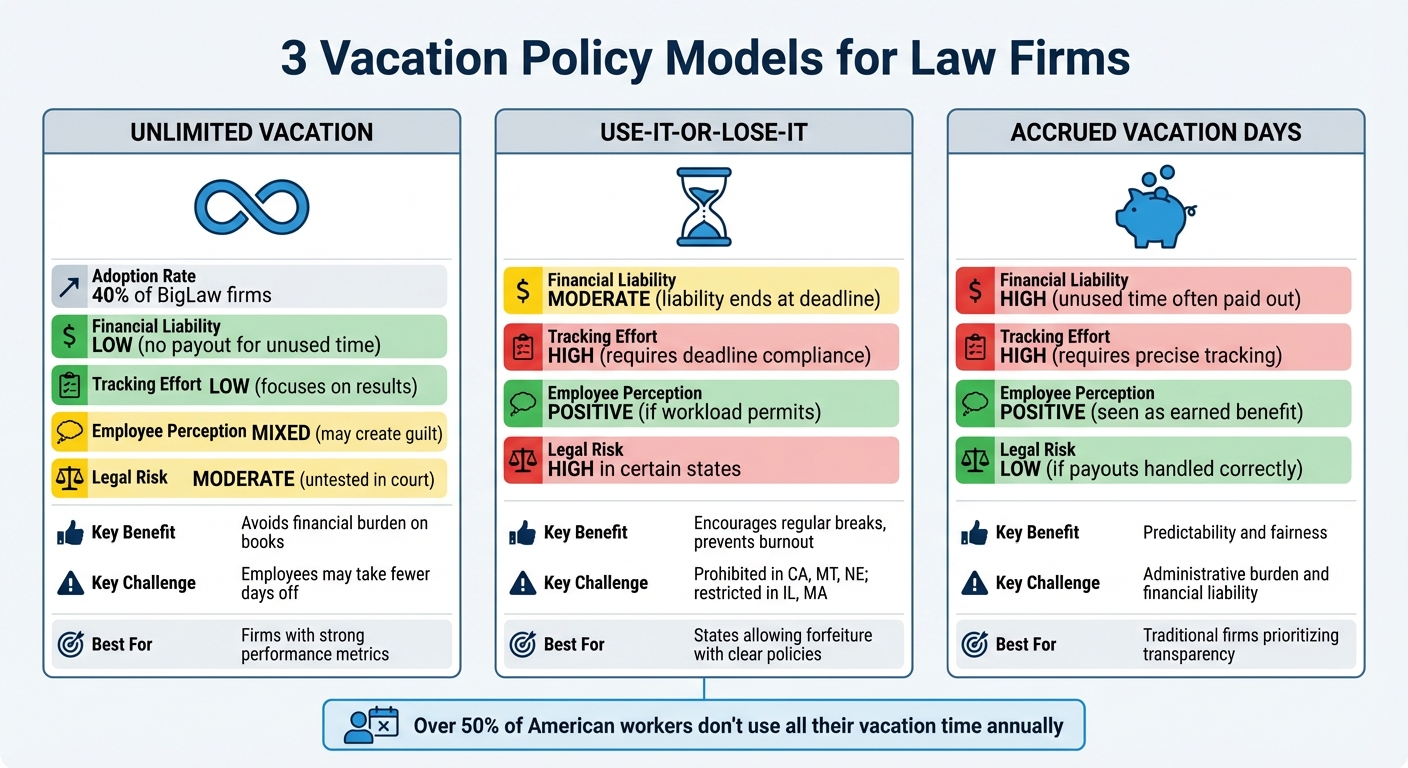
Comparison of Vacation Policy Types for Law Firms: Unlimited, Use-It-or-Lose-It, and Accrued Days
Law firms generally adopt one of three vacation models: unlimited, use-it-or-lose-it, and accrued days. Each approach comes with its own legal, administrative, and workplace dynamics that shape how attorneys take time off. These policies not only address operational needs but also reflect the firm’s values and priorities.
Unlimited Vacation Policies
Roughly 40% of BigLaw firms implement unlimited vacation policies, often referred to as “discretionary time off”. Under this system, employees can take leave as needed without maintaining an accrual balance, which helps firms avoid the financial burden of unused vacation time on their books.
However, studies show that employees with unlimited vacation tend to take fewer days off compared to those with set allowances. Dan Schawbel, an HR expert at Future Workplace, highlights a key issue:
“An unlimited vacation day policy creates more guilt around going on vacation because if you take too many days and your teammates don’t, you feel like they have the upper hand when it comes to career advancement.”
To make this model effective, firms need to establish clear performance goals or productivity benchmarks to ensure fair evaluations. Without these, attorneys may hesitate to use their time off, fearing it could reflect poorly on their commitment. Additionally, unlimited policies can be tricky to implement for non-exempt hourly staff, as their hours must be carefully tracked to comply with wage and overtime laws. While this approach reduces administrative complexity, it requires a supportive work environment to encourage attorneys to actually take breaks.
Use-It-or-Lose-It Policies
Use-it-or-lose-it policies require employees to use their vacation time by a set deadline – usually the end of the year – or forfeit it. This model aims to prevent burnout by pushing employees to take regular breaks. As legal commentator David Lat explains:
“A ‘use it or lose it’ policy encourages folks to actually take vacation – which can be surprisingly hard at certain law firms with a machismo around overwork.”
However, these policies are not universally allowed. In states like California, Montana, and Nebraska, accrued vacation is treated as earned wages and cannot be forfeited. In other states, such as Illinois and Massachusetts, use-it-or-lose-it is permitted only if employees are given a reasonable chance to use their time before the deadline. Firms adopting this model must ensure their policies align with state laws and should document all rules clearly. Labor attorney Doug Kauffman underscores this point:
“The number one thing is having a written policy. Putting all the rules down in writing establishes what people are eligible for.”
A well-crafted policy should include deadlines, notice requirements, and procedures for managing situations where workloads prevent employees from taking time off. While this approach can control long-term financial liabilities, it may feel rigid, especially for attorneys juggling demanding client schedules, potentially impacting morale and retention.
Accrued Vacation Days Policies
Accrued vacation policies follow a traditional model where employees earn vacation time incrementally, based on their pay periods or years of service. This time is stored in a “bank” that employees can draw from when needed. For example, attorneys might earn 10 business days annually during their first five years and 15 days after that.
This structure provides predictability, allowing attorneys to plan their vacations in advance. Research even suggests that the anticipation of a planned vacation can help reduce burnout. Additionally, accrued time is often viewed as a tangible benefit, fostering a sense of fairness and ownership.
However, the downside is the administrative burden. Firms must meticulously track hours earned and used, and any unused time becomes a financial liability until it is either taken or paid out. In many states, accrued vacation is considered earned wages, requiring firms to pay out unused time when an employee leaves. While this model offers transparency and reliability, the tracking requirements can complicate firm management.
| Policy Type | Financial Liability | Tracking Effort | Employee Perception | Legal Risk |
|---|---|---|---|---|
| Unlimited Vacation | Low; no payout for unused time | Low; focuses on results | Mixed; may create guilt | Moderate; untested in court |
| Use-It-or-Lose-It | Moderate; liability ends at deadline | High; requires deadline compliance | Positive if workload permits | High in certain states |
| Accrued Vacation | High; unused time often paid out | High; requires precise tracking | Positive; seen as earned benefit | Low if payouts are handled correctly |
Interestingly, over half of American workers fail to use all their vacation time annually. This highlights that policy design alone isn’t enough – firm leadership and workplace culture are critical in encouraging attorneys to take the breaks they need.
Managing Attorney Time Off Without Disrupting Operations
Designing vacation policies is just one part of the equation. Keeping client service running smoothly during attorney absences requires thoughtful planning and preparation.
Standard Vacation Allowances for Attorneys
Law firms often base vacation allowances on factors like seniority and tenure, offering longer-serving attorneys more time off. Consistency in applying these policies is key to maintaining fairness among staff. The ABA Model Rules of Professional Conduct emphasize this balance:
“A lawyer’s workload must be controlled so that each matter can be handled competently”.
This principle highlights the need to manage workloads effectively so attorneys can recharge without compromising the quality of client service.
Approval Processes and Blackout Periods
A centralized approval process helps prevent scheduling conflicts. Typically, an Office Manager or Senior Partner reviews and approves time-off requests. Firms should also require attorneys to submit vacation requests well in advance and establish blackout periods during peak workloads. For instance:
- Tax attorneys should avoid vacations during tax season.
- Litigators should steer clear of trial dates.
- Criminal defense attorneys might reconsider summer vacations when case volumes rise.
A shared vacation calendar can provide visibility into who will be out and when, helping to avoid overlapping absences and ensuring smooth operations.
Coverage Strategies During Attorney Absences
Maintaining client service during attorney vacations starts with proactive planning. Scheduling time off well in advance allows firms to coordinate with staff and clients. Larger firms can redistribute cases among colleagues, while smaller firms or solo practitioners might hire freelance attorneys for temporary support. Solo practitioners should also have a succession plan in place for unexpected absences.
To minimize disruptions, consider implementing a “phantom day” before and after vacations. These buffer days give attorneys time to wrap up tasks and address pressing issues without compromising client work. Additionally, staff can help by prioritizing communications, ensuring critical matters are handled promptly upon the attorney’s return.
Automated tools can also play a significant role. Systems like client intake forms and billing reminders keep operations running smoothly. For example, 57% of electronic payments through specialized legal payment systems are processed within the same day, and 85% within a week. These tools help firms maintain cash flow and avoid revenue gaps while attorneys are away.
How to Implement and Maintain Vacation Policies
Once you’ve decided on the type of vacation policy that fits your organization, the real work begins. Implementation and consistent upkeep are key to ensuring the policy serves both your team and your business effectively.
Writing Clear Vacation Policies
A well-written vacation policy sets the tone for effective management. Doug Kauffman, Labor and Employment Attorney at Balch & Bingham, emphasizes:
“The number one thing is having a written policy. Putting all the rules down in writing establishes what people are eligible for. [The policy] should cover all contingencies. That is key.”
Your policy should clearly define who is eligible, how vacation time accrues, and the notice required for requests. For instance, many companies ask for at least two weeks’ notice for non-emergency vacation requests. Additionally, include timelines for management to approve or deny requests, which helps avoid last-minute issues.
Another critical element is addressing unused vacation time. If you choose a “use-it-or-lose-it” approach, ensure it aligns with state labor laws. States like California, Montana, and Nebraska consider accrued vacation as earned wages, meaning those hours must be paid out upon termination, and forfeiture policies are not allowed. To protect both the company and employees, include a signed acknowledgment form to confirm that employees understand the policy.
Training Staff on Vacation Policies
Even the clearest policy won’t work if employees don’t understand it. Training is essential. Make sure your team knows how to submit vacation requests, who is responsible for approvals, and how to handle scheduling conflicts. Encourage employees, especially attorneys and staff, to plan for their workload during absences by using legal practice software by suggesting backup plans for client or project coverage.
Regular team meetings can also include vacation planning discussions. Talking about upcoming absences in advance helps smooth out workflows and avoids scrambling to find coverage. For unexpected absences, establish clear communication protocols – whether through Slack, email, or text – so emergencies are handled quickly and efficiently.
Regular Policy Review and Updates
Vacation policies shouldn’t be static. They need to evolve as laws and business needs change. Reviewing your policies at least once a year, often during January planning sessions, can ensure they stay relevant and compliant. Gathering feedback from employees can also reveal what’s working and what might need adjustment, helping you strike a balance between operational needs and employee satisfaction.
It’s also wise to consult a labor attorney or compensation expert periodically to confirm compliance with state and federal regulations. This is especially important if your company adopts flexible scheduling or modern PTO models. Regular updates keep your policy effective, fair, and aligned with your goals.
Using Software to Manage Vacation Policies
Relying on spreadsheets, sticky notes, or email chains to manage vacation policies can quickly lead to confusion and mistakes. Legal practice management software takes the hassle out of the process by automating tasks like tracking accrued days and syncing approved time off with the firm’s master calendar.
Adding Vacation Tracking to Daily Workflows
For vacation management to work smoothly, it needs to be part of your daily operations. Modern systems integrate directly with tools like Outlook, Google, or Apple calendars. When vacation requests are approved, firm-wide schedules are automatically updated, preventing issues like scheduling client meetings when attorneys are unavailable.
Having real-time visibility is just as important. Dashboards that show scheduled absences alongside current workloads make it easier for office managers to balance tasks and avoid disruptions when someone is out. For example, The Legal Assistant offers customizable calendars, and task management tools, giving teams a clear picture of attorney availability.
How Automation Reduces Administrative Work
Automation takes the back-and-forth out of managing vacation requests. Instead of manually calculating accrued days or chasing down approvals, software handles these tasks automatically. Employees can check their current and future balances instantly, without needing to contact HR, while requests are routed to the right person for quick, one-click approval.
By automating these processes, firms can cut down on errors and save time. Tasks like calculating accruals, enforcing policy rules (like accrual limits or blackout periods), and maintaining audit trails for compliance are handled seamlessly. This reduces administrative burdens, speeding up onboarding and issue resolution. In fact, attorneys can recover nearly half of their workday previously lost to admin tasks.
Conclusion
Crafting a vacation policy that works requires clear and well-documented guidelines. As Molly McGrath, Founder of Hiring & Empowering, explains:
“Clear, consistent guidelines help team members understand expectations while reducing the emotional weight around taking leave”.
For attorneys, taking time off must mean actually disconnecting from work. Bloomberg Law Analysis highlights this point:
“Organizations must go further by structuring their practices and legal departments in a way that allows lawyers to take time off free from ongoing work responsibilities”.
Achieving this involves setting advance notice requirements (such as a two-week minimum for non-emergency requests), establishing clear delegation protocols, and implementing coverage strategies to ensure smooth operations in someone’s absence. These measures don’t just support time off – they create a foundation for better productivity and sustainable careers.
Technology also plays a key role in making vacation policies more effective. By reducing administrative tasks and ensuring workflows run smoothly during absences, tech tools can make a big difference. Time off isn’t merely a benefit – it’s a necessity to prevent burnout and sustain productivity. As Shelley Awe puts it:
“Time away is crucial for productivity and career longevity”.
Despite its importance, time off is often underutilized, which is why structured and enforced policies are essential.
Tools like The Legal Assistant help balance time off with operational needs. Features like intelligent automation and integrated calendar tools simplify the process, allowing team members to submit leave requests and check balances from anywhere. Task management capabilities ensure responsibilities are reassigned before someone steps away. Plus, automated workflows, document generation, and billing keep everything running smoothly, even when key players are out.
FAQs
Which state’s vacation laws apply to remote attorneys?
Vacation policies for remote attorneys depend on the state where the attorney is physically working. States like California and Texas have their own rules regarding vacation pay and related policies. It’s crucial to check the employment laws of the specific state where the attorney is based to ensure everything aligns with legal requirements.
How can unlimited PTO work without discouraging time off?
Unlimited PTO thrives when clear guidelines are in place, helping employees gauge what constitutes a reasonable amount of time off. Creating an environment where taking time off is encouraged and seen as normal can reduce any uncertainty or reluctance employees might feel about using their PTO.
What’s the best way to cover client work during vacations?
Planning ahead and keeping communication open can make all the difference when you’re preparing for time away. Let your clients know about your upcoming absence well in advance. Provide clear instructions for handling urgent matters and assign a trusted colleague or assistant to step in for emergencies. Work with your team to check voicemails and manage any surprises that might pop up. Take care of billing schedules before you leave, and make sure your vacation dates are marked on the calendar to prevent scheduling conflicts. This way, your clients will feel supported, even while you’re out of the office.