

Missing a statute of limitations deadline can permanently end a client’s chance to recover damages and expose your firm to malpractice claims. This guide explains how personal injury firms can effectively manage these critical deadlines to protect clients and avoid costly mistakes.
Key takeaways include:
- Use personal injury case management software to track deadlines accurately.
- Set up automated alerts with reminders at multiple intervals.
- Standardize case intake processes to capture essential details like injury dates and jurisdiction.
- Assign clear accountability within your team to ensure deadlines are met.
- Regularly audit case files and maintain accurate documentation.
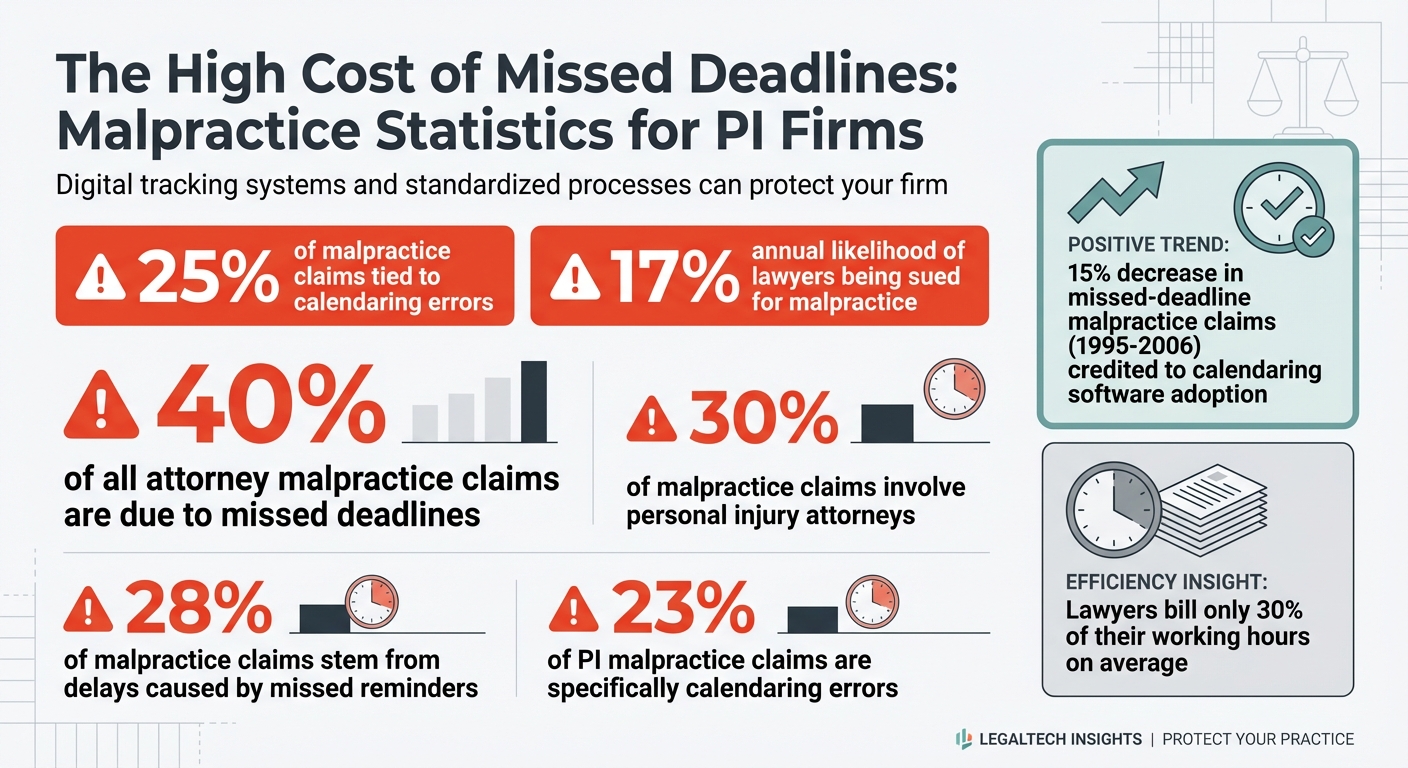
Malpractice Risk Statistics for Personal Injury Law Firms
Set Up a Centralized Deadline Tracking System
Why Manual Tracking Systems Fail
Using manual methods like spreadsheets, personal calendars, or paper diaries to track statutes of limitations can lead to serious risks for your firm. These systems rely heavily on human memory and manual calculations, which are prone to mistakes. In fact, about 25% of malpractice claims are tied to calendaring errors, such as missing filing deadlines or recording them incorrectly.
The risk grows when deadlines are scattered across individual calendars. If an attorney handling a case is unavailable due to illness or vacation, critical dates might be overlooked. According to an insurance vice president, the absence of strong calendaring and docket systems is one of the main reasons deadlines get missed. With lawyers facing a 17% likelihood of being sued for malpractice annually, sticking to manual tracking methods simply isn’t worth the gamble. This is where digital tools become essential.
Use Digital Calendars and Automation Tools
Digital tracking systems offer a practical solution to avoid these errors. These tools automatically calculate deadlines based on court rules and jurisdiction-specific requirements, removing the need for manual date counting. They even account for weekends, holidays, and local court procedures, ensuring deadlines are accurate. This eliminates the stress of manually tracking dates or accidentally overlooking a holiday that impacts filing timelines.
The key benefit of digital systems is centralization. With a centralized platform, all team members can access critical deadlines in real time. Modern systems sync seamlessly across devices, so attorneys can check their schedules on phones, laptops, or tablets alongside their daily appointments. Some tools also use visual aids, like color-coded indicators – red for pending deadlines and green for completed ones – to make it easy to prioritize urgent tasks.
Practice management tools such as The Legal Assistant take this a step further. They integrate deadline tracking directly into case files, creating a streamlined process where critical dates are captured and monitored from the moment a case begins. This eliminates the hassle of switching between multiple systems and ensures that no deadline is overlooked. However, even with advanced digital tools, additional safeguards are recommended.
Create Backup Alert Systems
Even the best digital calendars need extra layers of protection. Set up automated alerts at intervals like 90, 60, 30, 7, and 1 day before each deadline to ensure nothing slips through the cracks.
Many malpractice insurance providers now advise firms to maintain two separate calendar records for high-stakes deadlines. A dual-entry system can help verify that every critical date is accounted for. Some firms also use a Master File List, reviewed weekly, to cross-check digital records. These redundancies are crucial, especially since 28% of malpractice claims stem from delays caused by missed reminders.
sbb-itb-95f4849
Standardize Your Case Intake and Triage Process
Create a Statute of Limitations Checklist
To streamline your case intake process, start by standardizing how you gather essential deadline information. From the very beginning, make sure to capture critical dates like the date of injury, date of discovery (if applicable), jurisdiction, matter type (e.g., motor vehicle accident vs. medical malpractice), and any tolling factors (such as the plaintiff being a minor, mentally incapacitated, or the defendant being out of state). These details are key to calculating accurate deadlines.
Your intake forms should also flag whether a government entity might be a defendant. Cases involving government entities often have much shorter notice requirements, such as filing a claim within a specific timeframe.
Keep in mind, statutes of limitations vary by the type of tort. For example, in California, most personal injury claims have a two-year deadline, but libel or slander cases must be filed within a year. Using digital intake forms with mandatory fields ensures no case moves forward without capturing essential details like the incident date and jurisdiction.
Finally, customize your intake process to align with the specific rules of each jurisdiction.
Account for Jurisdiction-Specific Differences
Statutes of limitations for personal injury cases differ widely from one jurisdiction to another. For instance, states like Kentucky and Tennessee have one-year deadlines, while others allow more time. During triage, ask three critical questions:
- “Where did the accident happen?”
- “Where does the defendant live?”
- “Is the defendant a government employee or entity?”.
Be mindful of borrowing statutes, which sometimes require applying a shorter deadline from the state where the injury occurred, even if the case is filed elsewhere. For example, Florida’s 2023 reforms reduced the negligence claim deadline from four years to two. Cases from one-year states should be flagged immediately, and it’s also important to confirm whether the discovery rule applies. Some jurisdictions limit this rule to specific cases, like medical malpractice.
Here’s a quick reference for personal injury deadlines by state:
| State | Personal Injury Deadline | Notable Exceptions |
|---|---|---|
| California | 2 years | 1 year for libel/slander |
| Florida | 4 years | 2 years for libel/slander |
| Kentucky | 1 year | 2 years for car accidents |
| New York | 3 years | 1 year for assault/battery |
| Texas | 2 years | 1 year for libel/slander |
Audit Existing Case Files for Errors
Regular audits are crucial for catching errors in deadline calculations before they cause problems. Generate statute of limitations reports filtered by “incomplete” status to identify cases that need immediate attention. Use a Master File List and review it weekly to ensure all active cases have accurate deadlines and none are missed during staff transitions.
“Missing a date or deadline can have significant consequences. Your client may lose all recourse to advance or protect their interests, and a financial claim and complaint may be made against you.” – Law Society of Alberta
To minimize errors, restrict who can enter or modify deadlines. Limit this access to the lead attorney and one designated assistant. During audits, cross-check all dates against current legislation and court rules. Pay special attention to cases involving the discovery rule, where the clock might start later than the incident date. Use digital systems with audit trails to track who accessed or changed a deadline, ensuring accountability for any updates.
Build Team Accountability and Regular Review Processes
Having a centralized tracking system is just the start; team accountability is what keeps everything running smoothly. Even the best tracking tools won’t work if no one is clearly responsible for meeting deadlines. Assign specific deadlines to individual team members – whether they’re attorneys, paralegals, or support staff. This eliminates confusion, especially during transitions between different phases of a case, which is often where things go off track. While automated alerts are helpful, human accountability fills the gaps that technology alone can’t cover.
“Establishing clear productivity goals for individuals and teams… creates accountability and clarity.” – CASEpeer
To stay ahead of potential issues, schedule weekly or bi-weekly team meetings. Use these sessions to review cases nearing their statute of limitations, identify any factors that could pause deadlines, and flag urgent cases needing immediate attention. A centralized dashboard can provide real-time updates and ensure everyone has access to the same information, avoiding the creation of silos.
Shared calendars and automated task triggers can make assigning deadlines seamless as new cases come in. This system reduces the risk of anything slipping through the cracks, even during periods of staff transitions or vacations. Additionally, tracking key performance indicators (KPIs) – like case cycle times and response rates – can quickly highlight bottlenecks or areas where staffing adjustments might be needed.
Here’s a striking statistic: lawyers, on average, bill only 30% of their working hours. This points to inefficiencies in internal processes. By implementing standardized workflows and fostering accountability, firms can recover valuable time. Encourage team members to block daily focus time for high-priority tasks like developing case strategies. This ensures that critical work gets the attention it deserves without constant interruptions.
Automate Alerts and Build in Safety Margins
When it comes to managing deadlines effectively, combining automated alerts with built-in safety margins can significantly reduce risks and improve team accountability.
Set Up Automated Notifications
Automated alerts are a game-changer for preventing missed deadlines. By aligning your system with interval guidelines like 90, 60, 30, 7, and 1 day(s) before a deadline, you can ensure your team is consistently reminded. These notifications should be set up to reach your team through multiple channels – email, SMS, and internal dashboards – so no one is left in the dark.
Using rules-based docketing systems simplifies this process. These tools can calculate statute of limitations dates automatically based on the “Date of Accident” or “Event Date” and apply jurisdiction-specific rules. To keep deadlines visible, make sure notifications sync with popular calendar platforms your team already uses. Additionally, status toggles like “Satisfied” or “Unsatisfied” provide a quick way to track whether deadlines have been met.
While automated alerts are vital, they work best when paired with early internal deadlines to create extra breathing room for unexpected events.
Create Internal Deadlines Before Statutory Deadlines
Setting internal deadlines well ahead of statutory ones is a proactive way to avoid last-minute scrambles. A buffer of 30 to 60 days before the official filing date can help your team handle unexpected challenges like staff illnesses, tech failures, or emergencies. During the final 30 days, increase the frequency of reminders – weekly at first, then daily as the deadline approaches – to ensure it stays top of mind.
Here’s a sobering statistic: nearly 40% of all malpractice claims against attorneys are due to missed deadlines, with about 25% tied specifically to calendaring errors. Personal injury attorneys, in particular, face heightened risks, accounting for almost 30% of these claims. Establishing internal deadlines isn’t just a good practice – it’s a safeguard that can make the difference between success and costly mistakes.
To ensure these safeguards remain effective, real-time monitoring is essential.
Monitor Deadlines in Real-Time
Real-time monitoring adds a critical layer of oversight to your deadline management strategy. Many case management systems include dashboards or “Today Screens” that provide a clear view of upcoming deadlines and overdue tasks. Visual cues, like red tiles for urgent deadlines and gray for upcoming ones, make it easy to prioritize cases that need immediate attention. Assign a team member to review the dashboard daily, and have a backup ready to step in during absences.
Modern case management tools also offer dynamic recalculation features. For example, if a trial date is rescheduled, the system can automatically adjust all dependent deadlines, avoiding the chaos of manual updates. This “ripple-update” functionality prevents a chain reaction of missed procedural deadlines. Tools like The Legal Assistant provide centralized event management and customizable calendars, ensuring your firm has a clear, unified view of all deadlines without creating information silos.
Keep Accurate Records and Documentation
Even though legal software for paralegals can help track deadlines, detailed records are essential for verifying and supporting those critical dates. Thorough documentation can protect you against malpractice claims or case dismissals by showing compliance and explaining any tolling circumstances. To strengthen your tracking system, make sure to record all key dates and relevant details carefully.
Record Key Dates and Tolling Circumstances
Always document the exact date and time of the injury in every case file. For latent injuries, include the “discovery date”, which marks when the harm was first identified. Keep in mind that statutes of limitations vary by state – some allow 2 years, others 3 years – and the discovery rule can adjust the starting point.
You should also record any tolling circumstances that pause the statute of limitations. These could include factors like the plaintiff being a minor, mental incapacity, or the defendant being out of state. These details are crucial for calculating deadlines accurately. For cases involving government entities, track the notice of claim deadline separately. For instance, in Texas, you only have 6 months to file formal notice. In medical malpractice cases, don’t forget the statute of repose, which in Texas imposes a hard 10-year deadline, regardless of when the injury was discovered.
“Courts don’t bend on deadlines. If you file even one day late, the defendant can ask for a dismissal, and in most cases, the judge has to grant it.” – Evan Ullman, Author, THE702FIRM Injury Attorneys
Standardize File Organization and Naming Conventions
Once you’ve recorded all dates and circumstances, organize them for easy access. Set up a consistent folder structure for every case right from the start. For example, add the incident date to the matter file during intake – this becomes the foundation for calculating all statute of limitations deadlines. Use subfolders like “Discovery Items”, “Signed Documents”, “Medical Records”, and “Correspondence” to keep everything easy to locate.
Implement templated workflows for each stage of a case – such as onboarding, investigation, and discovery – to ensure files are consistently organized, no matter who handles them. This is especially important as digital evidence, like surveillance footage and smartphone data, now appears in over 50% of personal injury cases. Use a document checklist to confirm that critical items like accident reports, medical records, and physician notes are in the file before filing anything deadline-sensitive.
Keep Proof of Timely Filing
Store proof of timely filing in a dedicated folder to counter any claims of missed deadlines. Key documents to include are court-stamped complaints, proof of service, and any correspondence confirming receipt by the defendant or their attorney. For cases involving government entities, keep certified mail receipts and delivery confirmations for notices of claim.
Also, document any factors that could extend or pause the limitations period. For example, if a defendant leaves the state for over four months, maintain records of their absence to support tolling. In wrongful death cases, ensure the personal representative is properly documented, as they are typically the only party authorized to file within the two-year window following the date of death. Remember, settlement negotiations or insurance discussions do not pause the filing deadline – only filing a formal lawsuit stops the clock.
Conclusion
Summary of Key Strategies
Missing a deadline can have serious consequences for a client’s case and can even lead to malpractice claims. Personal injury attorneys face the highest risk, making up nearly 30% of all malpractice claims. Among these, calendaring errors account for 23%. The five strategies outlined in this guide work together to create a strong safety net: centralized digital tracking reduces the chance of scattered notes and human error; standardized intake processes ensure deadlines are recorded from the start of a case; team accountability prevents tasks from slipping through the cracks; automated alerts with built-in safety margins provide multiple reminders; and accurate documentation safeguards your firm if questions arise later.
These strategies complement one another seamlessly. Rules-based automation ensures deadlines are calculated accurately across jurisdictions, while tiered reminders – set at six months, three months, and one month – give your team plenty of time to prepare filings. Assigning both primary and secondary staff members to monitor deadlines ensures constant oversight. Between 1995 and 2006, the ABA reported a 15% decrease in missed-deadline malpractice claims, crediting the improvement to the growing adoption of calendaring software. By combining centralized tracking, standardized processes, team accountability, automated reminders, and precise documentation, your firm reinforces its commitment to staying on track and delivering for clients. These practices fit naturally into your daily workflow, helping ensure every case progresses smoothly.
How to Get Started
To put these strategies into action, start by moving all deadlines into a single, centralized system. Record the limitation period as soon as you open a new case – don’t wait until the investigation phase is over. Assign a dedicated docketing administrator to oversee entries and ensure that every court notice triggers a calendar update.
Set up tiered reminders and internal deadlines at least 30 days before the statutory cutoff. Regular team meetings can help review upcoming deadlines and address potential bottlenecks before they escalate. Many malpractice insurance providers now require firms to use rules-based docketing systems or offer premium discounts to those that do. This makes implementing these practices not just a smart choice but an essential step for protecting your business.
“It’s pure gold if you can get a firm to use its case-management system to raise accountability to a higher level.” – Risk Management Coordinator, Attorney Liability Protection Society
FAQs
Who should own statute-of-limitations entries and updates?
Statute-of-limitations entries and updates should be handled by the firm’s master user or a dedicated case management professional. This approach ensures deadlines are tracked accurately and updates are made on time, minimizing the chance of errors. By assigning this responsibility to a specific individual, accountability is reinforced, and the overall workflow becomes more streamlined.
What tolling issues should we check at intake?
At the start of a case, it’s crucial to identify any factors that might pause or extend the statute of limitations. For instance, if the injured party is a minor, legally incapacitated, or unaware of the injury due to the defendant’s concealment, these could affect the timeline. Other considerations include whether the defendant left the state or if there was ongoing criminal activity. Pinpointing these details early on ensures deadlines are correct and safeguards the client’s right to file a claim.
How early should our internal filing deadline be?
To ensure you don’t miss important statutes of limitations, it’s smart to set your internal filing deadline well before the legal cutoff. A widely recommended approach is to schedule it at least 30 days ahead of the statutory deadline. This extra time allows your team to review documents, organize materials, and handle any last-minute surprises, making the filing process much smoother. Setting deadlines 3 to 4 weeks in advance is a dependable strategy.