

Law firms handle sensitive client data, making them frequent targets for cyberattacks. With 29% of law firms reporting security breaches and the average cost of a data breach reaching $4.56 million by 2025, compliance with data privacy laws is critical. Firms must navigate complex regulations like HIPAA, GDPR, CCPA, and state-specific laws, while also meeting ethical obligations under ABA Model Rules. Penalties for non-compliance can be severe, such as GDPR fines of up to 4% of global revenue or $7,500 per violation under CCPA.
Key takeaways:
- Major Regulations: HIPAA, GDPR, CCPA, and New York’s SHIELD Act impose strict requirements.
- Ethical Standards: ABA Model Rules demand reasonable efforts to protect client data.
- Technology Solutions: Tools like secure cloud platforms, encryption, and multi-factor authentication reduce risks.
- Governance: Privacy policies, audits, and appointing a Data Protection Officer help manage compliance.
- Risk Mitigation: Regular training, privacy impact assessments, and automated tools simplify processes.
Staying compliant requires ongoing effort, regular updates to policies, and leveraging technology to safeguard client data while meeting legal and ethical standards.
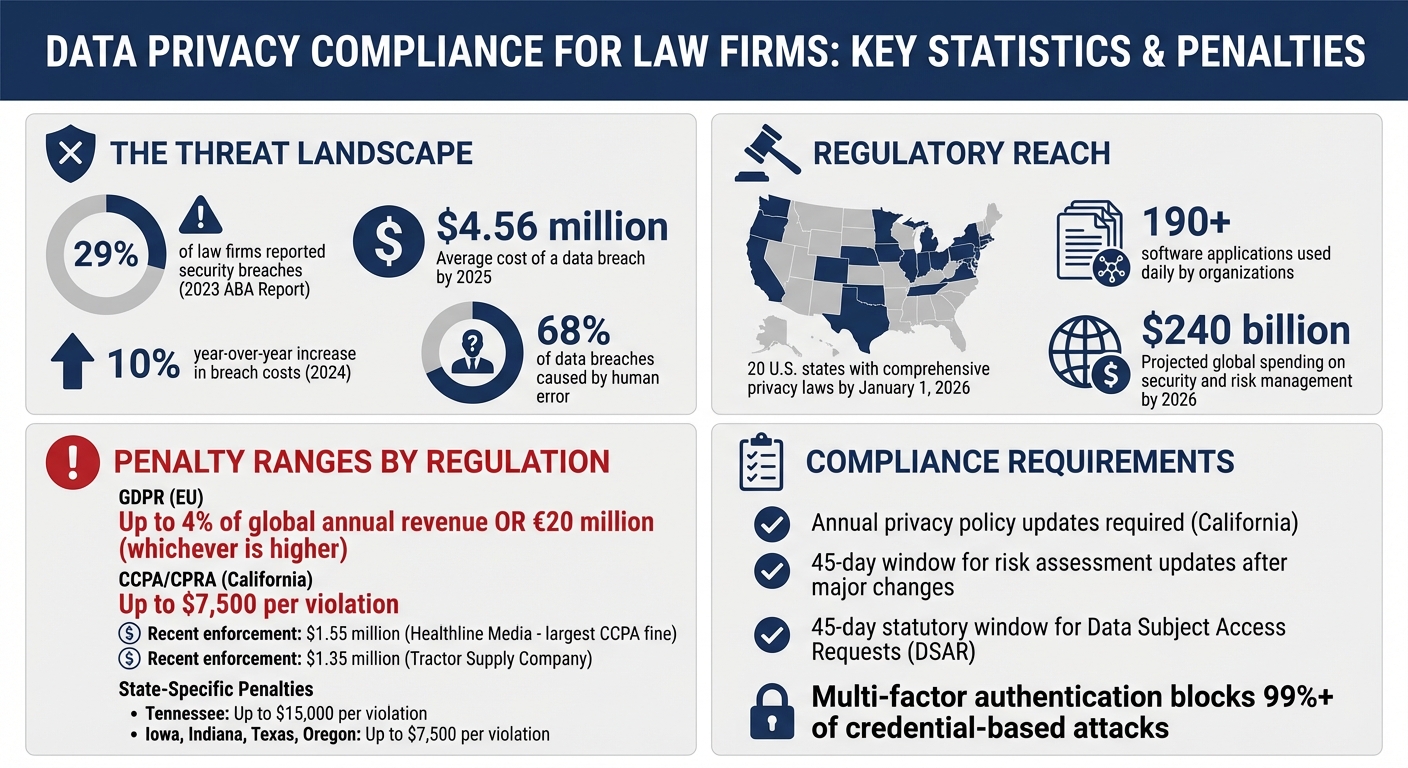
Data Privacy Compliance Statistics and Penalties for Law Firms 2025
Key Regulations Governing Data Privacy in Law Firms
Overview of Major Regulations (CCPA, HIPAA, GDPR, etc.)
Law firms in the United States must navigate a patchwork of privacy laws that vary by state and federal jurisdiction. Unlike countries with a single, unified federal privacy law, the U.S. operates under a decentralized system. As of July 31, 2025, 20 states have enacted comprehensive data privacy laws, requiring firms to comply with regulations based on their clients’ locations rather than their own.
Some regulations apply across specific industries or client types. For instance, HIPAA governs law firms acting as business associates for healthcare clients, enforcing strict rules on the handling of Protected Health Information (PHI). Meanwhile, the California Consumer Privacy Act (CCPA) and its amendment, the California Privacy Rights Act (CPRA), grant California residents rights such as accessing, deleting, and opting out of the sale of their personal data. Recent enforcement actions highlight the importance of compliance: in 2025, the California Privacy Protection Agency fined Tractor Supply Company $1.35 million for failing to notify consumers of their rights and lacking proper agreements with service providers. That same year, Healthline Media LLC faced a $1.55 million penalty – the largest CCPA-related fine to date – for failing to provide opt-out options for targeted ads and improperly sharing data that could suggest medical diagnoses.
For firms handling data from European Union residents, the General Data Protection Regulation (GDPR) applies, even if the firm is based in the U.S.. Additionally, state-specific laws further complicate compliance. For example, the New York SHIELD Act mandates safeguards for private information, while Massachusetts law (201 CMR 17.00) requires firms to draft a written information security plan when handling personal data of Massachusetts residents. Federal laws like the Gramm-Leach-Bliley Act (GLBA) and the FTC Act also play a role, with the latter empowering the Federal Trade Commission to address deceptive practices, including poor data security measures.
Penalties for non-compliance can be severe. Under the Tennessee Information Protection Act, violations can result in civil penalties of up to $15,000 per infraction. Other states, such as Iowa, Indiana, Texas, and Oregon, impose penalties of up to $7,500 per violation. These actions demonstrate regulators’ growing determination to hold businesses accountable for privacy breaches. Beyond legal requirements, law firms are also ethically obligated to adopt robust data protection measures.
Ethical Obligations Under ABA Model Rules
In addition to legal mandates, ethical guidelines set by the American Bar Association (ABA) further emphasize the importance of safeguarding client data. ABA Model Rule 1.6 mandates that firms implement measures to prevent unauthorized access or disclosure of client information. This includes using encryption, secure communication tools, and conducting thorough evaluations of third-party vendors.
ABA Rule 1.1, which outlines the Duty of Competence, extends to managing and protecting client data in a digital age. Meanwhile, Rules 5.1 and 5.3 assign responsibility to partners and senior lawyers to ensure that junior staff, non-lawyer assistants, and third-party vendors comply with confidentiality obligations , often by utilizing specialized legal software. Failing to meet these ethical standards can lead to disciplinary actions, malpractice claims, and damage to the firm’s reputation. To address these challenges, many firms are turning to modern compliance technologies to meet legal standards and uphold their ethical responsibilities in protecting client data.
sbb-itb-95f4849
Creating Privacy Policies and Governance Structures
Turning legal requirements into actionable practices starts with establishing privacy policies and governance structures. Law firms need to craft clear external notices and strong internal policies to manage data and respond to breaches effectively.
An external notice should clearly list the types of personal information collected – like names, email addresses, and case details – along with the reasons for collecting it, such as delivering legal services or complying with court orders. It should also disclose any third parties, such as IT vendors, hosting providers, or payment processors, that might access this data. Additionally, these notices must detail client rights.
Internal policies work alongside external notices by setting up access controls, breach response protocols, and assigning individuals to oversee privacy management. As Donata Stroink-Skillrud, Co-founder of Termageddon, notes:
A privacy policy is only as strong as the people who follow it.
Policies should be written in straightforward language, updated annually, or whenever significant technological changes occur. Conducting a privacy audit can help identify data processors and third-party access points. Tools like The Legal Assistant can simplify these tasks by offering features like data mapping and privacy audits.
Designating a Privacy Officer
Law firms should appoint a Data Protection Officer (DPO) if they engage in large-scale monitoring, such as tracking online behavior, or handle significant amounts of sensitive data like health records or criminal convictions. Even when not strictly required, having a dedicated Privacy Officer is a smart move. This person should operate independently, have sufficient resources, and report directly to top management. The Information Commissioner’s Office (ICO) emphasizes:
Your DPO must report to your highest level of management, operate independently, and have adequate resources to carry out their tasks.
The Privacy Officer’s responsibilities include overseeing compliance efforts like training, audits, and regulatory communications. Firms can assign this role to an existing employee, provided there’s no conflict of interest, or hire an external consultant. However, as The Law Society warns:
Your practice – not your DPO – is responsible if you do not comply with GDPR.
Given that organizations typically use over 190 different software applications daily, mapping personal data across these systems can be daunting. Once leadership roles are defined, systematic evaluations can help pinpoint and address data risks.
Conducting Privacy Impact Assessments
Privacy Impact Assessments (PIAs) are structured reviews of data processing activities that help uncover risks and compliance issues. These assessments are especially important when dealing with high-risk activities like targeted advertising, data sales, profiling, or processing sensitive personal information.
Start by mapping out how personal data flows within the organization, then weigh the risks against the benefits of processing that data. Sharon Bauer, Founder of Bamboo Data Consulting, explains:
A well-run Privacy Impact Assessment restores that visibility. It forces organizations to slow down long enough to see how personal information actually moves, who touches it, and where accountability really sits.
Effective PIAs involve stakeholders from IT, legal, security, and business teams to get a complete picture of data practices. Once risks are identified, firms can implement safeguards like encryption, access restrictions, and data minimization to address them. These steps not only reduce errors but also improve compliance processes. For example, Delaware’s regulations require PIAs only for data controllers managing information for at least 100,000 individuals.
The findings from PIAs should feed directly into updates for internal privacy policies, external notices, and Data Processing Agreements with vendors. This ensures that privacy practices remain aligned with both regulatory requirements and organizational needs.
Best Practices for Data Collection, Use, and Protection
After establishing strong privacy policies and governance frameworks, law firms need to focus on implementing effective strategies for data collection and protection. With global spending on security and risk management expected to hit $240 billion by 2026, it’s clear that secure data handling is more important than ever. Here are some actionable steps to help firms safeguard their data.
Obtaining and Managing Client Consent
Consent must be active and deliberate – passive actions like silence or pre-checked boxes don’t qualify. For example, firms can use an unchecked box with a statement like:
“By selecting ‘Continue,’ you confirm you have read and agree to the [linked privacy policy]”
to ensure clients actively opt in.
The Information Commissioner’s Office (ICO) highlights that consent requests should be:
“prominent, concise, easy to understand and separate from any other information such as general terms and conditions”.
Clients should also be able to withdraw consent as easily as they gave it. If consent is provided online, a one-step opt-out link should be available. According to UK GDPR Article 7:
“The withdrawal of consent shall not affect the lawfulness of processing based on consent before its withdrawal. It shall be as easy to withdraw as to give consent”.
Maintaining a detailed record of consent is critical. This includes tracking who consented, when (with timestamps), what information was provided (e.g., policy version), and how consent was given. If privacy practices change – such as when new data types are collected or third-party processors are introduced – firms should request updated consent. The Connecticut Data Privacy Act (CTDPA) also prohibits using “dark patterns” to manipulate user choices. To keep consent current, firms might consider refreshing it every two years or more frequently if data practices evolve.
While managing consent is vital, technical safeguards are equally important for protecting client data.
Implementing Technical Safeguards
Technical measures are the backbone of data security. Multi-factor authentication (MFA) is a must – it can block over 99% of credential-based attacks. This should be implemented across email systems, practice management software, and remote access platforms. Password managers that generate and store strong, unique passphrases of 12+ characters are also essential.
Encryption plays a critical role in safeguarding data. Use protocols like TLS and HTTPS to protect data in transit and AES-256 encryption to secure data at rest. Role-based access controls (RBAC) ensure that employees only access data relevant to their roles, following the principle of least privilege. For remote work, full-disk encryption tools like FileVault or BitLocker and remote wipe capabilities are vital for securing data on lost or stolen devices.
Secure client portals are another key tool for protecting sensitive communications. Training clients on how to use these portals can further protect attorney-client privileged information. Additionally, firewalls help block malicious traffic, and guest Wi-Fi networks can isolate visitor access from internal systems.
| Safeguard Category | Specific Measure | Purpose |
|---|---|---|
| Authentication | Multi-Factor Authentication (MFA) | Prevents unauthorized access via stolen credentials |
| Data Protection | AES-256 encryption and TLS protocols | Ensures data remains unreadable without a key |
| Access Management | Role-Based Access Control (RBAC) | Restricts data access to necessary personnel |
| Device Security | Full-disk encryption and remote wipe | Secures data on lost or stolen devices |
| Network Security | Firewalls and guest Wi-Fi isolation | Blocks threats and protects internal systems |
Retention and Deletion Protocols
Data should only be retained as long as necessary to meet legal or business requirements. Establish specific retention periods for different types of data, such as client files, financial records, or correspondence. When data is no longer needed, ensure it is permanently and securely deleted.
Immutable off-site backups, encrypted and resistant to tampering, are essential for disaster recovery or breach response. Conduct annual audits to confirm that former employees no longer have access to systems and that outdated data has been properly removed.
Failing to comply with data protection laws can result in hefty penalties. GDPR violations can cost up to 4% of a firm’s global annual revenue or €20 million, whichever is higher. Meanwhile, the California Consumer Privacy Act (CCPA) imposes fines of up to $7,500 per violation. By following clear retention and deletion protocols, firms can reduce legal risks and minimize the volume of data exposed to potential breaches.
Using Technology to Simplify Compliance
Relying on manual compliance processes often leads to mistakes. For example, staff may forget to include privacy disclosures in engagement letters or fail to track consent records accurately. Legal practice management software can help reduce these risks by embedding compliance safeguards directly into everyday workflows. Here’s how automation features make compliance simpler and more reliable.
Key Features That Support Compliance
The Legal Assistant includes several automation tools designed to address compliance challenges. Its document generation tool uses customizable MS Word templates to ensure client correspondence always includes the latest privacy disclosures. Automated email filing links correspondence to the correct case files, reducing the risk of oversight. The task management feature tracks critical dates – like statutes of limitation – and sends automated reminders via email and dashboards, helping firms meet regulatory deadlines outlined in laws like the CCPA and GDPR.
Additionally, the platform integrates multiple modules into a single database, eliminating duplicate data entry. Firms can also choose between secure cloud hosting or on-site installation to meet data residency requirements based on jurisdictional rules. These features not only enhance compliance but also streamline operations overall.
Benefits of Automation for Privacy Management
Automation brings a level of consistency that manual processes simply can’t achieve. As LawBhoomi explains:
“Often, non-compliance stems from inconvenience or cumbersome manual processes. Intuitive, user-friendly technology solutions encourage adoption and make it easier for team members to follow the firm’s established policies.”
- LawBhoomi
Built-in privacy protocols ensure compliance by reducing human error. Role-based permissions restrict access to sensitive case information based on job roles, maintaining the principle of least privilege. This is especially critical given the high costs of data breaches. Additionally, automation helps with financial compliance. For instance, The Legal Assistant’s billing management features support proper trust accounting practices, which are vital for IOLTA compliance and preventing the mixing of client and firm funds.
Monitoring and Maintaining Compliance Over Time
Once you’ve established privacy policies and implemented technical safeguards, the next step is to ensure you’re keeping up with changes. Privacy compliance isn’t a one-and-done task – it’s an ongoing process. As privacy attorney Harry Richt points out, continuous management and improvement are key. The regulatory landscape is constantly evolving. By January 1, 2026, 20 U.S. states will have comprehensive privacy laws in place, each with its own definitions, consumer rights, and enforcement mechanisms. What worked last year might not cut it today.
Regulators are also raising the bar by demanding proof of compliance. For example, California’s Privacy Protection Agency now requires annual evidence-based cybersecurity audits for eligible businesses, with deadlines staggered by revenue size through April 1, 2030. The stakes are high: as of 2024, the average cost of a data breach has risen by 10% year-over-year. And the risks are real – 29% of law firms reported experiencing a security breach in the 2023 ABA Cybersecurity TechReport. These numbers highlight why proactive monitoring is more than just a regulatory checkbox; it’s a financial necessity.
Regular Policy Reviews and Updates
Privacy policies aren’t static documents – they need regular attention. California law, for instance, mandates annual updates to privacy policies, and risk assessments must be revisited within 45 days of any major change. What counts as a major change? Think adopting generative AI tools, switching data vendors, or expanding into new markets.
Take Tractor Supply as an example. In 2025, California regulators penalized the company for failing to update its privacy policy annually – a clear violation of state requirements. That same year, regulators in California, Colorado, and Connecticut collaborated on an enforcement sweep targeting businesses that ignored Global Privacy Control (GPC) signals. Outdated policies are an easy target for regulators, especially when they fail to address newly enacted state-specific rights.
To avoid these pitfalls, businesses should schedule regular policy audits with legal counsel. Make sure all required privacy links, like “Do Not Sell or Share My Personal Information”, are functional after any website redesigns or platform migrations. Test your DSAR processes to confirm data can be located and delivered within the 45-day statutory window. Pair these reviews with ongoing training to keep your team prepared for new challenges.
Training and Awareness Programs
Let’s face it: human error is often the weakest link in data security. Under ABA Model Rule 1.6, lawyers are required to “make reasonable efforts to prevent the inadvertent or unauthorized disclosure of, or unauthorized access to, information relating to the representation of a client”. This responsibility extends to ensuring that all employees are aware of current threats.
Training isn’t a one-time event – it should be continuous. Offer sessions for both new hires and current staff, focusing on how to identify advanced threats like AI-generated phishing scams and social engineering attacks. Quarterly phishing simulations can help gauge real-world readiness and pinpoint employees who might need extra support. Role-specific training is also crucial. For example, billing staff should learn about encrypting payment data, while paralegals need tips on securely sharing documents.
As Donata Stroink-Skillrud, Co-founder of Termageddon, wisely puts it:
A privacy policy is only as strong as the people who follow it.
Encourage a workplace culture where employees feel safe reporting potential breaches without fear of blame. When everyone understands that data protection is a shared responsibility, compliance becomes more than just a task – it becomes part of your organization’s DNA.
Conclusion
Data privacy compliance has become a crucial responsibility for law firms, with recent breach reports highlighting the severe financial and reputational risks involved. As Gavin Miller aptly states:
Safeguarding client and firm data is not just commendable; it’s ethically imperative for lawyers.
The regulatory environment continues to evolve rapidly. States like Maryland, New Jersey, and Minnesota have introduced comprehensive privacy laws, each with distinct requirements. Additionally, cybersecurity failures are now being treated as governance issues, potentially leading to securities law violations and even personal liability for firm leadership. This shift underscores that compliance is no longer just the IT department’s concern – it’s a critical issue for firm leadership and boardrooms. These changes also highlight the growing importance of technology-driven solutions.
Technology provides practical tools to help firms navigate compliance challenges. Legal practice management software equipped with encryption, role-based access controls, and automated retention protocols can help mitigate risks and reduce human error, which accounts for 68% of data breaches. Cloud-based platforms often enhance security compared to on-premise servers, offering benefits like automatic updates and dedicated security teams. Tools like The Legal Assistant integrate these features while also streamlining operations, making them a valuable asset for law firms aiming to improve data privacy practices.
Successful firms treat privacy compliance as an ongoing effort. Regularly updating policies, providing continuous staff training, and carefully vetting vendors are essential steps in building a culture of data protection. With global spending on security and risk management expected to hit $240 billion by 2026, investing in advanced technology and strong processes today is more than just a smart move – it’s an ethical obligation and a way to maintain a competitive edge.