

When it comes to taking on new clients, choosing the wrong one can cost your law firm time, money, and even its reputation. A structured client screening process helps you avoid these risks by identifying cases that align with your expertise and resources. Here’s what you need to know:
- Why it matters: Poor screening can lead to ethical violations, unpaid fees, and malpractice claims. Fee disputes alone are a leading cause of these issues.
- Key steps: Start with a conflict check, assess the client’s goals and finances, and ensure their expectations align with your firm’s capabilities.
- Red flags: Watch for clients with a history of switching attorneys, unrealistic demands, or complaints about fees.
- Use tools: Automating intake tasks can save time and reduce errors, allowing you to focus on serving the right clients.
A clear and thorough screening checklist not only protects your firm but also ensures you’re prioritizing cases that are a good fit for your practice.
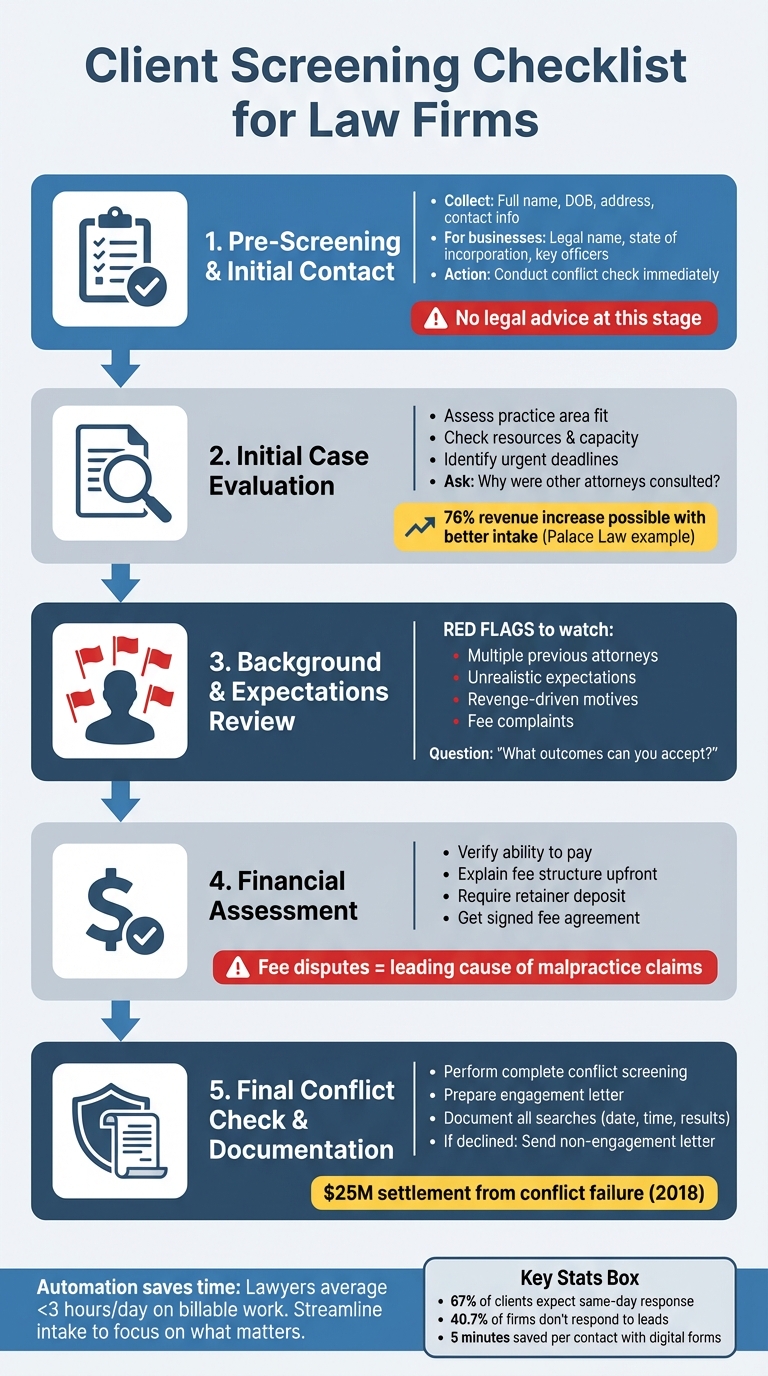
5-Step Client Screening Process for Law Firms
Pre-Screening: Collecting Initial Information
The first interaction with a potential client is crucial – it sets the tone for the entire screening process. Before diving into a consultation, gathering key details helps you decide if the case is worth pursuing. This step also saves your firm from investing time and resources in cases that might not be a good fit while flagging potential conflicts early.
Initial Contact and Conflict Check
Your intake staff plays a vital role in this process. As Sherri Roycroft, Paralegal and Office Administrator at The Brocker Law, puts it:
Your intake staff also functions as a gatekeeper. They are on the front lines and can gauge the client’s suitability.
During that initial phone call or email exchange, collect essential details like the client’s full legal name, any aliases or former names, date of birth, current address, phone number, and email. For business clients, include the entity’s full legal name, state of incorporation, headquarters address, and names of key officers or directors.
Before scheduling a consultation, initiate a conflict check. Identify everyone involved in the matter – this includes adverse parties, opposing counsel, and any affiliated businesses. The ABA Model Rule 1.7 emphasizes the importance of conflict checks:
To determine whether a conflict of interest exists, a lawyer should adopt reasonable procedures, appropriate for the size and type of firm and practice, to determine in both litigation and non-litigation matters the persons and issues involved.
The rule also warns:
Ignorance caused by a failure to institute such [conflict checking] procedures will not excuse a lawyer’s violation of this Rule.
When conducting a conflict check, account for name variations or common misspellings (e.g., Jon vs. John) to avoid missing potential matches due to data entry errors. For corporate clients, extend your search to include parent companies and subsidiaries, as many outside counsel guidelines prohibit representing any member of a corporate family. To catch conflicts that automated systems might miss, consider circulating a list of prospective matters to all firm personnel.
Another critical point: train your intake staff to avoid giving legal advice during this early stage. Make it clear to potential clients that no attorney-client relationship exists until the conflict check is complete and a formal engagement letter is signed.
Once conflicts are cleared, you can shift focus to assessing whether the case aligns with your firm’s expertise.
Initial Case Evaluation
After gathering the necessary client details, evaluate whether the case fits your practice. Start by asking for a brief description of the issue, the jurisdiction involved, and the client’s specific goals or desired outcomes.
Determine whether the case falls within your firm’s core practice areas and assess whether you have the time, staff, and resources to handle it effectively. Teresa Matich from Clio highlights the importance of this step:
The easiest way to waste time on client intake is to onboard clients that aren’t a good fit.
Taking on the wrong cases drains resources that could be better spent elsewhere.
Be mindful of any urgent deadlines, such as filing requirements or statutes of limitations, to avoid potential malpractice risks. If the client has already consulted other attorneys, ask why they were turned down. A history of rejections may indicate potential challenges like unrealistic expectations, financial concerns, or difficult behavior.
It’s also essential to discuss the client’s budget and ensure they understand and accept your fee structure. Addressing financial matters early on can help prevent disputes later.
For example, in 2017, Palace Law – a personal injury firm with 22 staff members – revamped its client intake process to collect critical information more effectively. This overhaul allowed the firm to hit its annual revenue targets by the end of the third quarter, achieving a 76% increase in year-over-year revenue.
By carefully evaluating the client and case during this stage, you can determine whether they align with your firm’s goals, setting the stage for a more detailed review in subsequent steps. A thorough pre-screening process not only filters out unsuitable clients but also ensures you have the capacity to focus on the right ones.
| Category | Information to Collect | Purpose |
|---|---|---|
| Identity | Full name, aliases, date of birth, address | Identification and entry into conflict system |
| Conflict | Adverse parties, related entities, counsel | Ethical clearance and risk management |
| Matter | Case type, jurisdiction, deadlines | Ensuring practice area fit and meeting deadlines |
| Business | Budget, prior attorneys, client objectives | Assessing financial feasibility and fit |
sbb-itb-95f4849
Reviewing Client Background and Expectations
After completing the initial conflict check and confirming that the case aligns with your practice area, it’s time to take a closer look at the client’s background and mindset. This step is critical for spotting potential red flags, such as unpaid invoices, unreasonable demands, or a history of jumping from one attorney to another.
Checking Client History
Pay attention to whether a client has consulted multiple attorneys for the same matter – this can be a major warning sign. As Lockton Affinity, LLC explains:
“If a potential client has already been through three lawyers before contacting your firm, it could indicate unrealistic expectations or a payment-avoidance strategy.”
Be direct and ask why they are seeking new representation. Their response can be revealing. Negative remarks about previous attorneys might indicate a challenging client. Reaching out to their former lawyers can also provide valuable context. You may learn that the case was declined due to lack of merit or because of personality clashes.
It’s equally important to understand the client’s motivations. Are they genuinely seeking a legal resolution, or are they driven by revenge or anger? Clients motivated by emotions rather than practical outcomes often have expectations that no firm can meet. Trust your instincts here. As Colleen Williams of Martindale-Avvo points out, clients with unstable finances or unreasonable demands can pose significant risks to your practice.
Finally, take time to evaluate whether the client’s goals align with what your firm can realistically provide.
Evaluating Client Expectations
Building on your understanding of their history, assess whether the client’s expectations are both realistic and compatible with your expertise. Many clients come in with ideas shaped by television dramas or sensationalized media coverage. They might expect massive settlements, quick resolutions, or guaranteed outcomes – none of which reflect the complexities of real-world legal cases. Use open-ended questions to gauge their perspective. For example, asking, “Knowing there are no guarantees, what outcomes can you accept?” can help you understand whether they grasp the uncertainties involved.
Also, consider their timeline. If they expect complex litigation to be resolved in weeks or demand immediate results, take the time to explain the actual process. How they react to this information can reveal a lot. Clients who resist your professional guidance or insist on unrealistic deadlines are more likely to be dissatisfied later.
Another crucial step is determining whether their goals align with your firm’s capabilities. Do you have the necessary expertise, time, and resources to handle their case effectively? Utilizing case management features can help you track these resources and ensure your firm isn’t overextended. Taking on cases that stretch your firm’s limits can increase malpractice risks and harm your reputation. If their needs exceed what you can provide, it’s better to decline the case and issue a formal non-engagement letter to avoid misunderstandings.
Finally, review the client’s payment history. Clients who are overly focused on costs or make disparaging comments about fees are statistically more likely to engage in disputes. In fact, a significant number of malpractice claims and grievances stem from fee disputes or attempts to collect unpaid bills.
| Red Flag Category | Specific Warning Signs |
|---|---|
| Attorney History | Multiple previous lawyers; “shopping” the case around; negative comments about former counsel |
| Expectations | Unrealistic outcomes; demanding quick resolutions; resistance to professional advice |
| Financials | Complaints about fees; inability to pay retainers; history of unpaid bills |
| Character | Revenge-driven motives; inconsistent stories; uncomfortable or evasive behavior |
Financial Assessment and Fee Agreement
After understanding the client’s background and setting realistic goals, the next step is determining whether they can meet the financial commitment required for your services. This involves verifying their ability to afford your fees and their willingness to adhere to your billing structure. Discussing fees upfront during the initial consultation helps establish clear expectations and sets the tone for a smooth working relationship.
Assessing Financial Ability
Start the consultation by explaining your billing process, accepted payment methods, and terms. As the American Bar Association highlights, “Transparency regarding fees is crucial for setting expectations and ensuring that clients can afford your services in a manner that works for both parties”.
Examine the client’s financial history, particularly for any unpaid invoices or past fee disputes. USI Affinity advises caution if a client appears hesitant or evasive about committing to a fee agreement, noting that “Is the client evasive or reluctant in connection with a commitment to abide by a fee agreement?”. Such behavior may signal potential issues down the road.
Evaluate whether the client’s financial needs align with your firm’s practices. Some clients might request non-standard fee arrangements. If a third party is responsible for covering legal fees, address any ethical concerns associated with this arrangement early on. Requiring a retainer deposit can also help gauge the client’s commitment; reluctance to provide a deposit may indicate future payment challenges.
Once you’ve confirmed the client’s financial capability, ensure they fully agree to your fee structure.
Reviewing Fee Agreements
Use a written engagement letter or retainer agreement to clearly outline how fees will be calculated – whether based on hourly rates, flat fees, or contingency arrangements. As the Canadian Bar Association advises, “The lawyer’s fee structure and billing requirements… should be a shared understanding [before being retained]”.
Define the scope of services explicitly to avoid confusion or potential scope creep. Include details about the initial retainer amount, how it will be replenished, and note that any unearned funds will be held in a trust account and refunded if the engagement ends. Be transparent about additional costs, like filing fees or travel expenses, and specify whether these will be included in the fee or billed separately. Establish a billing schedule, such as monthly invoices, and outline consequences for non-payment, such as interest charges or potential withdrawal from the case.
Secure the client’s agreement by obtaining a physical or electronic signature on the fee agreement. If signing immediately isn’t possible, specify that receipt of the retainer deposit will serve as formal acceptance. If the client cannot meet your financial terms or refuses to sign the agreement, issue a non-engagement letter to formally decline representation.
Ethical and Legal Requirements: Conflict Checks and Documentation
Once financial arrangements are in place, the next critical step is ensuring ethical compliance through thorough conflict checks and proper documentation. After confirming the fee agreement, it’s essential to verify that no ethical or conflict issues remain. This step safeguards both your firm and your clients from risks like disqualification, fee losses, or malpractice claims. The stakes are high – just consider the 2018 case where a Scottish law firm settled a conflict of interest claim for about $25 million (£19 million), highlighting the serious financial consequences of inadequate conflict screening.
Performing a Complete Conflict Check
Conflict checks don’t stop after the initial evaluation. They should be conducted at several key stages: before the first consultation, before signing an engagement letter, and whenever a new party is added to the matter. To ensure accuracy, collect detailed information about all relevant parties, including current, former, and prospective clients, as well as adverse parties.
For individuals, gather:
- Full legal names, maiden names, and nicknames
- Dates of birth
- Addresses
For businesses, include:
- Legal names and trade names (d/b/a)
- State of incorporation
- Parent companies, subsidiaries, officers, directors, and major shareholders
Using a management system with fuzzy search capabilities can help identify variations in names. Attorney Willie Peacock cautions against relying on memory for conflict checks, a mistake that can have serious repercussions. Yet, many lawyers still don’t use conflict-checking software – 59% of solo practitioners and 34% of small firm lawyers report not having such tools.
To improve accuracy, assign a centralized conflicts manager or have a second partner review the results to eliminate bias. Document every search with details like the date, time, and names checked. If you hire a lateral attorney or new staff, screen them for conflicts arising from their previous employment before they start working.
If a conflict is discovered, assess whether it can be waived. If so, obtain informed written consent from all affected parties. For conflicts that cannot be waived, issue a formal non-engagement letter to decline representation. The ABA Model Rule 1.7 Comment emphasizes:
Ignorance caused by a failure to institute such procedures will not excuse a lawyer’s violation of this Rule.
Preparing Required Documentation
Maintaining comprehensive records is crucial. Keep intake questionnaires and conflict check logs that detail search dates, times, and results. These records can serve as evidence that proper procedures were followed if a conflict issue arises later.
Draft engagement letters that clearly outline the scope of representation, including who is and isn’t a client. Lucian T. Pera, Partner at Adams and Reese LLP, underscores the importance of this practice:
Being rigorous in identifying who is (and who is not) your client, in writing, every time you open a new matter, and documenting that in the conflicts system is desperately important to avoiding conflicts.
For corporate clients with multiple affiliates, specify which entities you represent and explicitly exclude others to avoid unintended client relationships. If you decline representation after a consultation, send a non-engagement letter that confirms no attorney-client relationship was formed. Even prospective clients who don’t proceed with your firm should be added to your conflict database, as Model Rule 1.18 could disqualify your firm based on information obtained during an initial consultation.
If you address a conflict using an ethical screen or “wall”, document its implementation and notify all affected parties in writing.
| Document Type | Purpose | Key Information to Include |
|---|---|---|
| Intake Form | Initial Data Capture | Full names, aliases, date of birth (for individuals), state of incorporation (for entities), adverse parties |
| Conflict Search Record | Compliance Proof | Date and time of search, name variations searched, person conducting the check |
| Engagement Letter | Formalizing Relationship | Scope of work, fee arrangements, identity of the client, and exclusions of specific affiliates |
| Conflict Waiver | Ethical Clearance | Description of the conflict, associated risks, and the client’s signed informed consent |
| Non-Engagement Letter | Risk Mitigation | Clear statement that no representation was accepted and no confidential information was retained |
Using Technology to Improve the Screening Process
Manual client screening eats away at billable hours, leaving lawyers with limited time for their core work. On average, attorneys dedicate less than 3 hours per day to billable tasks, with the rest of their time consumed by administrative duties like client intake. This inefficiency clashes with client expectations: 67% of legal consumers anticipate a response the same day they contact a firm, yet 40.7% of law firms fail to respond to lead form submissions at all.
Once you’ve set up a solid screening checklist, automating these tasks can take your intake process to the next level. Legal practice management software and tools can handle screening tasks, freeing up valuable hours. For example, one-click conflict check features can instantly scan firm emails, files, and contacts, replacing the slower, traditional method of firm-wide emails and waiting for replies. Digital intake forms allow clients to provide their information anytime, syncing it directly into your system. This simple shift can save up to five minutes per contact created.
Jennifer Reynolds, a family lawyer and founder of Fresh Legal in Ottawa, demonstrates the power of automation. She uses Zapier to streamline her intake process: when a prospective client fills out her online form, the data is automatically transferred into her practice management software. This setup creates a “new contact” immediately, but a “new matter” is only generated after the client officially retains the firm. This eliminates duplicate data entry and keeps the process efficient.
Tools like The Legal Assistant go even further, centralizing client information and automating follow-up tasks. Features such as document generation, task management, intelligent automation, and event management ensure a smoother workflow. By automating routine processes, law firms can maintain consistent screening practices, reduce staff workload, and ensure every prospect is attended to – allowing attorneys to focus on what they do best: practicing law.
Conclusion
Using a thorough screening checklist isn’t just about protecting your firm – it’s about working smarter. Taking on the wrong client can drain your resources, harm your reputation, and even lead to malpractice claims. Fee disputes, a common trigger for such claims, highlight the importance of careful client selection. As Sherri Roycroft, Paralegal and Office Administrator at The Brocker Law, wisely points out:
If you get it right on the front end, you won’t have to withdraw from a case you should never have taken in the first place.
But the benefits go beyond reducing risks. A standardized checklist can make your operations far more efficient. On average, lawyers spend less than three hours a day on billable tasks. Every minute saved during the intake process translates into more time for revenue-generating work. A well-organized system can significantly improve both efficiency and profitability.
A smooth intake process doesn’t just save time – it also builds trust. When potential clients go through a seamless, professional experience that includes clear fee structures and realistic expectations, they’re more likely to feel confident in your firm. This trust can lead to more referrals and stronger relationships. As Teresa Matich from Clio explains:
Investing in your client intake process and implementing legal intake solutions means more than just adding operational efficiencies for your practice: You’ll serve your clients better, enhance your reputation, and drive more referrals to your firm.
FAQs
What information should we collect before booking a consultation?
Before setting up a consultation, law firms need to collect some essential details. This includes basic biographical information, contact details, and a brief summary of the client’s case. It’s also critical to perform a conflict of interest check to properly screen for any potential complications.
How can we spot client red flags early?
Spotting potential red flags in clients early on is crucial for managing risks and ensuring a healthy attorney-client relationship. Some common signs to watch for include clients with a history of firing multiple attorneys, those who exhibit dishonest behavior, act unpredictably, make excessive or unreasonable demands, or hold expectations that are simply not realistic. During initial consultations, take note of their motives, communication style, and overall behavior. These early observations can provide valuable insights and help prevent conflicts or dissatisfaction down the line.
What should a fee agreement always include?
A fee agreement should lay out key details to avoid misunderstandings. These include the scope of representation, the type of fee arrangement (like hourly or flat rate), the advance deposit amount, the billing cycle and payment terms, and any costs or expenses the client will cover. Clearly defining these elements promotes transparency and sets clear expectations for both the attorney and the client.