

AI is transforming legal work, but it comes with risks. By 2026, 80% of U.S. lawyers were using AI, yet only 10% of firms had formal governance policies. This gap has led to errors like fabricated case citations, data breaches, and ethical violations. Here’s how to mitigate these risks:
- Establish AI Governance: Create a board to oversee AI use, set clear data protocols, and conduct regular audits.
- Define AI Use Cases: Use a “traffic light” system to classify tasks as prohibited, high-risk, or low-risk.
- Ensure Human Oversight: Require lawyers to verify all AI-generated outputs before client use.
- Protect Client Data: Use secure tools with strong encryption, access controls, and zero data retention agreements.
- Train Staff: Offer mandatory AI training to reduce errors and ensure compliance with ethical standards.
- Monitor AI Usage: Track tool performance, error rates, and adherence to policies.
AI can improve efficiency, but without proper controls, it risks malpractice claims and reputational harm. Firms must implement structured policies, continuous oversight, and robust training to responsibly integrate AI into legal practice.
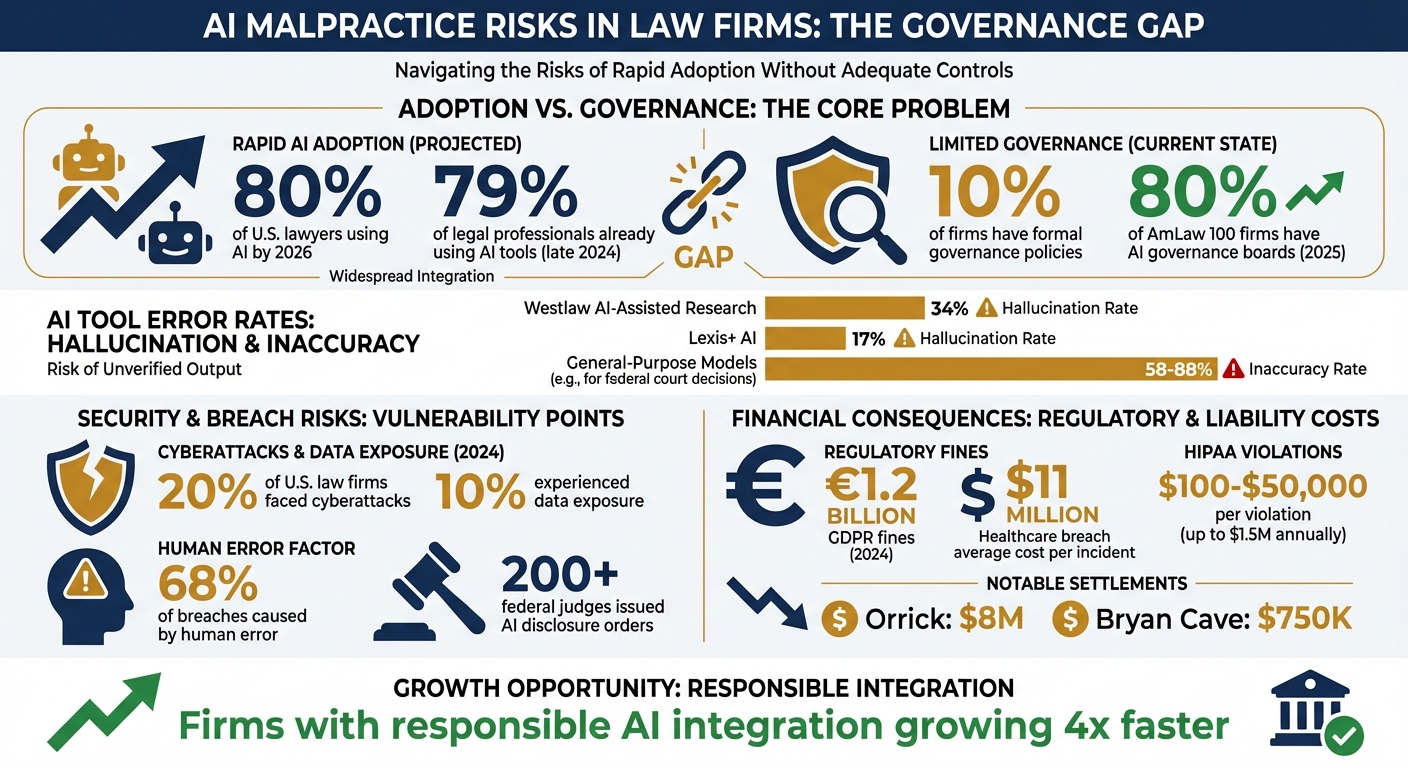
AI Adoption vs Governance Gap in Law Firms: Key Statistics and Risk Indicators
Create an AI Policy and Governance Framework
A solid governance framework is critical to addressing the risks tied to AI use in legal practice. By late 2024, 79% of legal professionals were already using AI tools, but this widespread adoption comes with potential liabilities. On the other hand, 80% of AmLaw 100 firms had formal AI governance boards in place by 2025, highlighting the importance of structured oversight in mitigating these risks.
An AI Governance Board should include senior leadership, the CIO, compliance officers, and representatives from high-use practice groups. During the initial rollout, monthly meetings are recommended, transitioning to quarterly once processes are established. The board’s responsibilities should include vendor evaluations, setting clear data handling protocols, and developing incident response plans for AI-related errors or breaches.
Define Acceptable AI Use Cases
AI applications vary in risk, and firms need clear boundaries for their use. A “traffic light” classification system can help guide staff:
- Red Light: Prohibited tasks, such as inputting confidential client data into public AI tools or generating legal advice without human review.
- Yellow Light: Tasks requiring heightened oversight and department head approval, including legal research, contract analysis, document review, and deposition summaries. These tasks should undergo documented risk assessments and full human verification.
- Green Light: Low-risk tasks, such as creating marketing content, handling administrative work, and managing internal knowledge, which only require standard precautions.
This system is essential given the error rates of AI tools. Research from Stanford HAI revealed that Westlaw AI-Assisted Research had a 34% hallucination rate, while Lexis+ AI showed a 17% rate. By clearly defining AI-appropriate tasks, firms can minimize misuse in high-risk areas. Maintaining a centralized whitelist of approved AI platforms is also crucial. This list should identify tools vetted for security and confidentiality, specifying which can handle sensitive data and which are limited to public information.
With these use cases in place, assigning oversight roles ensures the framework is applied effectively.
Assign AI Oversight Responsibilities
Clear accountability for AI outputs is a must. The matter-responsible lawyer should always serve as the final reviewer for any client-facing work, taking ultimate responsibility for its quality. Practice group leaders can manage day-to-day implementation of AI policies, setting specific task guidelines for their legal areas. IT and security teams should oversee technical approvals, enforce access controls, and ensure vendors meet security standards like SOC 2 Type 2 certification. Meanwhile, risk or compliance officers should conduct quarterly audits, monitor regulatory updates, and ensure adherence to ethics rules.
For high-risk tasks, firms should implement verification logs that document reviewers, citations checked, and any corrections made. These logs serve as evidence of due diligence if questions arise later. Additionally, a designated individual should track changes in state bar ethics opinions and court-specific standing orders. This is particularly important as federal judges have issued over 200 standing orders requiring lawyers to disclose AI use in court filings.
Conduct AI Risk and Impact Assessments
Before rolling out any AI tool, law firms need to take a hard look at potential risks like malpractice claims, data breaches, and ethical violations. By late 2024, only 10% of law firms had formal governance policies in place. This lack of preparation leaves firms vulnerable to liability and ethical challenges.
Start with a detailed risk assessment that examines critical areas such as privacy violations, unauthorized data exposure, algorithmic bias, and breaches of attorney-client privilege. It’s also essential to review malpractice and errors and omissions (E&O) policies, paying close attention to exclusions for AI-related errors. Watch out for “silent AI” clauses that might leave you unprotected against issues like fabricated citations or data breaches caused by AI tools.
This process should naturally lead to a full audit of all AI tools currently in use at your firm. Document everything – data flows, vendor security certifications, and more. Often, this process will reveal “shadow IT”, or unauthorized tools that staff have adopted without approval. To stay compliant with evolving ethical standards, maintain a repository of jurisdiction-specific bar opinions and court orders, such as ABA Formal Opinion 512.
Identify Ethical and Legal Risks
AI tools come with unique ethical and legal challenges that traditional software doesn’t. For instance, research from Stanford HAI found that Westlaw AI-Assisted Research had a 34% hallucination rate, while Lexis+ AI showed a 17% rate. These errors can lead to fabricated case citations, misrepresented legal holdings, or advice based on outdated or incorrect information – issues that could harm clients and damage your reputation.
Algorithmic bias is another significant concern. AI systems trained on historical data often replicate and even amplify existing biases. This is particularly problematic in areas like predictive analytics or employment screening. If the training data lacks diversity or reflects discriminatory patterns, the AI’s outputs may carry those same issues. As Kriton Papastergiou puts it, “AI should be designed to minimize bias and promote equitable outcomes”.
Confidentiality breaches are perhaps the most glaring risk. Inputting client data into consumer-grade AI tools that use the information for model training can violate attorney-client privilege. Firms should verify whether the tools they use offer Zero Data Retention (ZDR) agreements, ensuring that client data won’t be used to train the provider’s models. Additionally, any AI use involving personal data or cross-border transfers should undergo a Data Protection Impact Assessment (DPIA).
Once risks are assessed, the next step is to evaluate vendor reliability to ensure compliance and data security.
Evaluate AI Vendor and Tool Reliability
Not all AI tools are created with legal work in mind. General-purpose AI systems often predict legal text based on public data without fully understanding legal doctrines, jurisdictions, or consequences. In contrast, legal-specific tools that use Retrieval-Augmented Generation (RAG) base their outputs on verified legal databases like vLex or Fastcase, minimizing the risk of hallucinations.
When assessing vendors, a structured approach works best. The 4 Cs Framework is a helpful guide: evaluate Criticality (how serious an error could be), Confidentiality (data security), Complexity (how explainable the tool’s logic is), and Comfort (ease of use and team adoption). Prioritize vendors with security certifications like SOC 2 Type II or ISO 27001 to ensure high standards of data protection.
| Evaluation Criteria | Key Questions for Vendors |
|---|---|
| Data Usage | Is client data used to train your global models? Is there an opt-out? |
| Security | Do you have SOC 2 Type II or ISO 27001 certification? |
| Accuracy | Is the tool grounded in a specific legal database (e.g., Westlaw, Lexis, vLex)? |
| Transparency | Can the tool provide citations and explain its reasoning logic? |
| Compliance | Does the tool support GDPR, CCPA, and HIPAA requirements? |
| Retention | What are the data deletion protocols upon contract termination? |
Before moving forward, confirm that the vendor provides a formal Data Protection Agreement (DPA). This should clearly define roles, with the vendor as the “data processor” and the firm as the “data controller.” Under GDPR, vendors are required to notify clients of data breaches within 72 hours. If a vendor can’t provide clear documentation of their security practices, they’re not ready to handle your firm’s sensitive data.
Implement Human Oversight and Verification
AI tools can churn out documents and research faster than any person ever could, but they can’t replace professional judgment. Despite their efficiency, specialized legal AI tools often have notable error rates, making human verification an absolute must before submitting work to a client or court.
The American Bar Association (ABA) emphasized this in Formal Opinion 512, stating that competence “requires that lawyers exercise ‘an appropriate degree of independent verification or review’ of an AI’s output to prevent reliance on misleading or inaccurate information”. This isn’t just good practice – it’s a professional obligation. Attorneys are ultimately responsible for ensuring the accuracy of their work. By late 2024, more than 200 federal judges had issued standing orders requiring lawyers to disclose their use of AI and certify that a human verified the outputs.
Establish Review Protocols for AI Outputs
To ensure thorough oversight, a structured review system should be part of any governance framework. Every AI-generated output needs to be vetted for accuracy and relevance. For instance, citations should be verified using tools like Shepard’s or KeyCite, and the logic should align with standard legal reasoning frameworks such as IRAC or CRAC. AI can sometimes blend federal and state laws, so it’s critical to confirm the content reflects the correct jurisdiction’s laws and terminology.
Maintaining a record of who reviewed the document, what elements were checked, and any corrections made is also key. This creates a clear audit trail in case questions arise later. Consider using a “traffic light” system for prioritizing reviews: low-risk tasks like internal memos can receive lighter scrutiny, while high-risk tasks like court filings demand slower, more detailed checks. Ultimately, all AI-generated work should receive final sign-off from an attorney.
| Review Protocol | Specific Action Required |
|---|---|
| Citation Check | Confirm every case with a primary source and run it through a citator like Shepard’s or KeyCite. |
| Fact Check | Cross-check all dates, events, and factual assertions against original documents. |
| Logic Audit | Ensure the reasoning follows IRAC/CRAC and applies the correct legal tests. |
| Compliance Check | Verify adherence to local court rules, including formatting and procedural requirements. |
| Bias Review | Identify and correct any misrepresentation of case holdings or biased language. |
These steps lay the groundwork for a reliable and collaborative approach to AI oversight.
Promote Collaborative Decision-Making
Beyond detailed review protocols, a collaborative approach to oversight can further reduce risks of malpractice. Think of AI as a fast, confident assistant that still needs supervision.
“AI shows up in practice as a co-worker with two defining traits: speed and certainty. Those traits create a predictable failure mode. Output reads as competent, which nudges lawyers and staff to treat a draft as ‘close enough’ and move on”.
One effective strategy is implementing a “lawyer-in-the-loop” (LITL) workflow. Here, AI handles the initial drafting, data extraction, or triage, while the lawyer remains responsible for review, decision-making, and final approval. Clearly define which tasks AI can assist with, such as drafting or recommending, and which tasks must remain exclusively human, like approving and sending. For example, in late 2024, an employment law group piloted AI for drafting position statements and managed to cut drafting time by 30–40% through a strict lawyer-in-the-loop review process.
Introduce mandatory “verification gates” for critical elements like citations and facts, ensuring they are cleared by a human before any work product is shared externally. Additionally, create a no-blame channel where staff can report AI errors – such as incorrect citations or data leaks – without fear of repercussions. This enables quick action to address mistakes before they escalate into major issues.
“AI is powerful – but it’s also prone to mistakes. Hallucinations. Misinterpretations. Weird outputs. The legal profession thrives on good judgment, and that’s still very much a human thing”.
Protect Data Privacy and Security
Client data is the backbone of any law practice, but AI tools introduce new vulnerabilities that could compromise this sensitive information. In 2024 alone, 20% of U.S. law firms faced cyberattacks, and nearly 10% experienced data exposure, highlighting the urgent need for stronger data protection measures.
The stakes are enormous under regulations like GDPR and HIPAA. GDPR fines reached a staggering €1.2 billion in 2024, while HIPAA violations can range from $100 to $50,000 per violation, capped annually at $1.5 million. For law firms handling medical data, the average cost of a data breach in the healthcare sector is a jaw-dropping $11 million per incident. Alarmingly, 68% of breaches are caused by human error, often due to misconfigured systems or improper tool usage. This makes secure data storage and strict access controls non-negotiable.
Implement Secure Data Storage and Access Controls
Start with multi-layered encryption: AES-256 for data at rest and TLS 1.3 for data in transit. To stay ahead of emerging threats, some legal AI platforms are adopting post-quantum cryptographic standards. A “Zero Trust” approach is essential: verify every user, minimize privileges, and assume breaches can happen.
Role-based access controls (RBAC) should be a priority. Not everyone in the firm needs access to every file. Limit access on a “need-to-know” basis and enforce multi-factor authentication (MFA) using tools like FIDO2 or WebAuthn security keys. Avoid SMS-based MFA, as it’s vulnerable to interception.
When choosing AI vendors, look for those offering “Zero Data Retention” (ZDR) agreements, ensuring your data isn’t stored or used to train third-party AI models. Vendors with SOC 2 Type II and ISO 27001 certifications demonstrate a commitment to maintaining strong security controls.
“Any AI vendor handling regulated data should be able to back up their claims with clear, documented practices. If they can’t show you how they protect your information, they aren’t ready to work with it.” – Tara Swaminatha, ZeroDay Law
Consider hosting sensitive work on private cloud instances or “air-gapping” systems to isolate firm data. Services like Azure OpenAI allow firms to host models within their own tenant, using private networking to prevent leaks. Tools like Microsoft Purview can apply sensitivity labels (e.g., “Client Confidential”) to automatically encrypt and restrict document access.
Here’s how to address common AI security risks:
| AI Security Risk | Mitigation Strategy | Policy Control |
|---|---|---|
| Data Leakage | DLP on prompts/outputs; private endpoints | Ban public AI for client data; enforce secure environments |
| Shadow AI | CASB discovery; block/coach policies | Maintain an “Approved Tools” list; exceptions via governance board |
| Key Compromise | Secrets management; rotation; conditional access | Service principal standards; no keys in code or prompts |
| Prompt Injection | Content filtering; RAG with curated repositories | Use approved data sources; human review of outputs |
Comply with Data Privacy Regulations
Legal compliance isn’t optional. Under GDPR, AI vendors must notify clients of breaches within 72 hours. HIPAA requires notification within 60 days. Vendor contracts should explicitly outline these timelines and include breach notification protocols.
For firms handling Protected Health Information (PHI), HIPAA classifies them as “Business Associates”, requiring a Business Associate Agreement (BAA) with AI vendors. Without a BAA, firms risk severe financial and reputational damage. Similarly, under GDPR, a Data Protection Agreement (DPA) is essential. This document clarifies whether the vendor acts as a “controller” or “processor” and outlines technical safeguards for data.
Conduct Data Protection Impact Assessments (DPIAs) for any AI use involving personal data or cross-border transfers, as required by GDPR Article 35. Always anonymize inputs before submitting them to AI platforms unless you’re using a secure, firm-approved environment. Strip out names, case numbers, and other identifying details.
The consequences of weak data protection are severe. In 2024, Orrick, Herrington & Sutcliffe settled for $8 million after a 2023 breach exposed data on 638,000 individuals. Similarly, Bryan Cave Leighton Paisner paid $750,000 after a breach compromised data for 51,000 client employees. These cases highlight the financial and reputational risks of inadequate safeguards.
Finally, regularly audit your vendors. Review their breach notification processes and subprocessor transparency. Use Cloud Access Security Brokers (CASB) to detect and block “Shadow AI” tools, which could lack adequate data retention controls. With 99% of cloud security incidents expected to result from human error or misconfiguration by 2025, ongoing training and vigilance are essential.
sbb-itb-95f4849
Train Staff on AI Usage and Best Practices
To complement strong governance and security measures, equipping staff with comprehensive AI training is crucial for using these tools responsibly. While many legal professionals now rely on AI tools, formal governance policies are still rare. Without proper training, the risk of errors or malpractice increases significantly – especially since general-purpose language models produce inaccurate responses in 58% to 88% of cases involving U.S. federal court decisions.
Provide Regular AI Training Programs
A structured, multi-tiered training program can help staff use AI tools effectively. Start by ensuring new hires complete 4 hours of AI literacy training, covering how AI works, its limitations, and firm-specific policies. This should be followed by mandatory annual refreshers (2 hours) to address new risks, regulations, and updates to AI tools. Tailor training to specific roles, as litigation teams, transactional staff, and administrative personnel often have different needs. For high-risk applications – like legal research or document review – require tool-specific certifications before use.
Practical skills are essential. Staff should learn to identify “hallucinations” (e.g., fabricated legal precedents or nonsensical case citations) and treat AI outputs as drafts requiring thorough verification against primary sources. Implement “human-in-the-loop” workflows where every fact, citation, and conclusion is independently checked before being used in client work.
Data hygiene must also be a priority. Train staff to avoid uploading confidential client data into public AI tools. Teach best practices for prompt engineering, such as crafting prompts that require AI to indicate confidence levels, cite sources, and highlight inconsistencies. Maintain a central repository of approved prompts while clearly documenting prohibited patterns to reduce the risk of data leaks.
Compliance training is equally important. With over 200 federal judges requiring AI disclosure in court filings, attorneys need guidance on obtaining informed client consent and handling AI-related billing transparently. Link these elements to Continuing Legal Education (CLE) credits and emphasize supervisory responsibilities under Model Rules 5.1 and 5.3.
To prepare for potential failures, conduct “red team” exercises simulating AI errors or cyberattacks. Require staff to maintain verification logs that document who reviewed AI outputs, which sources were checked, and any corrections made. These logs can serve as critical evidence in the event of malpractice claims.
| Training Component | Frequency | Target Audience | Focus Area |
|---|---|---|---|
| AI Literacy | Upon Hire (4 hrs) | All Personnel | AI basics, limitations, and firm policies |
| Annual Refresher | Yearly (2 hrs) | All Personnel | New risks, regulations, and tool updates |
| Tool-Specific | Pre-adoption | Specific Users | High-risk application mechanics |
| Ethics/CLE | Annual | Attorneys | Professional liability and Model Rules |
| Red Team Drills | Periodic | IT & Legal Teams | Security incidents and hallucination detection |
Technical training is essential, but fostering a supportive culture ensures these practices are applied consistently.
Build a Culture of Responsible AI Use
While technical training provides the groundwork, a culture of responsible AI use ensures these practices stick. When senior associates and partners actively use approved AI tools, it naturally encourages broader adoption. Appoint “AI Champions” or “AI Stewards” within practice groups to bridge the gap between technology and legal workflows.
“AI does not replace the lawyer – it replaces the lawyer who refuses to learn AI.”
– Vani Sriranganayaki, Head of Communications at Justice Accelerator
Leverage the “traffic light” system to establish clear boundaries for AI use. Create a safe environment where staff can report AI errors or hallucinations without fear of retaliation if acting in good faith. Provide clear escalation paths so employees know who to approach when they encounter questionable AI outputs.
“Training that changes behavior has three traits: short modules tied to specific workflows, reinforcement through quick audits, and clear escalation paths for mistakes.”
– Jon Dykstra, Legal AI Strategist, Jurvantis.ai
Encourage innovation from the ground up by hosting internal challenges where staff identify low-risk, high-administrative tasks for AI pilot programs. For instance, LegalMation reduced the time needed to draft complaint responses from 6–10 hours to just 2–3 minutes. Organize workshops where leaders demonstrate AI-augmented workflows to normalize responsible use. Regular audits – monthly or quarterly – can help detect unauthorized tool usage or policy violations. Firms that integrate AI responsibly are growing at four times the rate of those that don’t.
Monitor AI Usage and Update Protocols
Keeping a close eye on AI usage is critical for maintaining effective policies and minimizing risks of malpractice. By late 2024, only 10% of law firms had formal governance policies in place. This lack of oversight creates liability gaps, especially as specialized legal AI tools continue to generate inaccurate information at alarming rates.
Track AI Tool Performance and Usage Patterns
Effective monitoring builds on existing oversight protocols to ensure AI tools remain compliant and functional. Here’s what to focus on:
- Usage Metrics: Measure how often tools are used and their adoption rates across different practice groups.
- Quality Metrics: Keep tabs on hallucination rates, citation accuracy, and adherence to legal reasoning frameworks like IRAC or CRAC.
- Operational Efficiency: Assess time saved on tasks like drafting documents or conducting research to evaluate the return on investment.
Monthly reports by practice group can highlight usage trends, while quarterly audits help uncover unapproved AI tools. Tools like Microsoft Purview or a Cloud Access Security Broker (CASB) can automate the detection of unauthorized applications and potential data leaks. Maintain an AI risk register that identifies risks, assigns owners, and outlines mitigation strategies. Additionally, require attorneys to log their reviews and corrections of AI-generated outputs for accountability.
| Metric Category | What to Track |
|---|---|
| Tool Performance | Hallucination/error rates, citation accuracy, logic audit scores |
| Firm Operations | Time saved per task, cost savings, ROI, billing transparency |
| Risk & Compliance | Training completion, client consent rates, incident/leak frequency |
| Usage Patterns | Frequency of use by tool type and practice group adoption |
References:
Update Policies to Address New Risks
AI policies must evolve alongside technology to tackle emerging risks effectively. During adoption and pilot phases, AI governance boards should meet monthly for the first six months, transitioning to quarterly meetings afterward for ongoing oversight. Quarterly compliance audits and usage reviews ensure adherence to firm standards. Policies should be updated annually – or sooner if regulations or technology change.
Quick action is especially important when new court standing orders, state bar ethics opinions, or regulatory changes arise. For instance, federal judges have issued over 200 standing orders mandating attorneys disclose AI use in court filings. Additionally, corporate clients are adding AI-specific requirements to their outside counsel guidelines.
To stay prepared, conduct AI-specific incident response drills, such as testing for “prompt leak” scenarios, twice a year. Clear escalation paths should guide staff on whom to contact when encountering questionable AI outputs or potential data breaches. Develop detailed incident playbooks with step-by-step protocols for handling AI failures, whether they involve confidential data exposure or hallucinations in filed documents.
Conclusion
By early 2025, nearly 80% of law firms have embraced AI, but only 10% have formal governance policies in place. This lack of structure creates significant malpractice risks, especially given that legal AI tools can produce hallucinations at rates ranging from 17% to 34%. The checklist provided earlier outlines essential steps to address this gap, from building governance frameworks and conducting risk assessments to ensuring human oversight, safeguarding client data, training staff, and monitoring AI usage. It serves as a step-by-step guide to help firms implement AI responsibly.
Federal judges are also stepping in, with over 200 standing orders now requiring AI disclosure in court filings. Meanwhile, corporate clients are embedding AI-specific clauses into their outside counsel guidelines. Firms that fail to adapt risk facing sanctions, malpractice claims, and a loss of trust from their clients.
Adopting a structured approach to AI not only mitigates risks but also supports growth. Firms that integrate AI responsibly are growing four times faster than those that don’t. Success hinges on selecting the right tools and pairing them with clear policies, mandatory verification processes, and continuous oversight. Integrated management solutions play a critical role in this process.
Practice management software, like The Legal Assistant, offers a way to balance innovation with control. With features such as document generation, task management, intelligent automation, and secure cloud hosting, it helps law firms streamline their operations without compromising attorney oversight. When paired with the governance practices outlined earlier, tools like these allow firms to leverage AI’s advantages while keeping malpractice risks in check.
AI is no longer a distant possibility for the legal profession – it’s already here. The real question isn’t whether your firm will adopt AI, but whether it will govern it effectively.
FAQs
What AI tasks should our firm ban outright?
Law firms need to steer clear of using AI for tasks that demand legal judgment, professional discretion, or the ability to provide sound legal advice. This includes generating legal opinions or making decisions without thorough human review. Similarly, handling sensitive client information or drafting legally binding documents should only involve AI if it’s specifically designed to meet legal compliance standards and is under strict supervision. Human oversight is essential to minimize risks like errors, bias, or ethical violations in these critical areas.
How do we verify AI citations and facts before filing?
To ensure accuracy in AI-generated legal citations and facts, law firms should meticulously verify all references against reliable legal sources, such as case law, statutes, and trusted legal databases. Double-check details like case names, docket numbers, and legal citations to confirm they are correct and legitimate. It’s also important to assess the content for jurisdictional relevance and adherence to legal standards. Ultimately, a qualified attorney should perform a thorough review to identify and correct any errors or fabricated details before the material is submitted or filed.
What contract terms ensure client data isn’t retained or used for training?
To protect client data, contracts should include clear clauses that:
- Ban the AI provider from retaining, sharing, or using client data without explicit consent.
- Restrict data usage strictly to the purposes outlined in the agreement.
These measures help ensure client confidentiality is maintained and align with ethical practices.