

By 2026, AI is a core part of legal work, but it comes with risks. Data breaches, AI-generated errors, and regulatory violations are on the rise. For example, 23% of law firms experienced AI-related breaches in 2024, and lawyers have faced sanctions for submitting inaccurate AI-generated content. Compliance is critical, as states like California and New York enforce strict reporting rules with penalties up to $30 million per violation.
Key takeaways:
- AI Incidents: Include breaches, misuse of AI, and algorithmic discrimination.
- Reporting Deadlines: Vary by state (e.g., 24 hours in California for urgent issues, 72 hours in New York).
- Client Communication: Lawyers must disclose material breaches and protect privilege.
- Risk Management: Use approved AI tools, including legal software for paralegals, verify outputs, and implement governance protocols.
To stay compliant, law firms must understand reporting rules, monitor AI use, and communicate transparently with clients. Missing deadlines or failing to manage AI risks can lead to financial penalties and reputational damage.
What Are AI Incidents and Reporting Requirements?
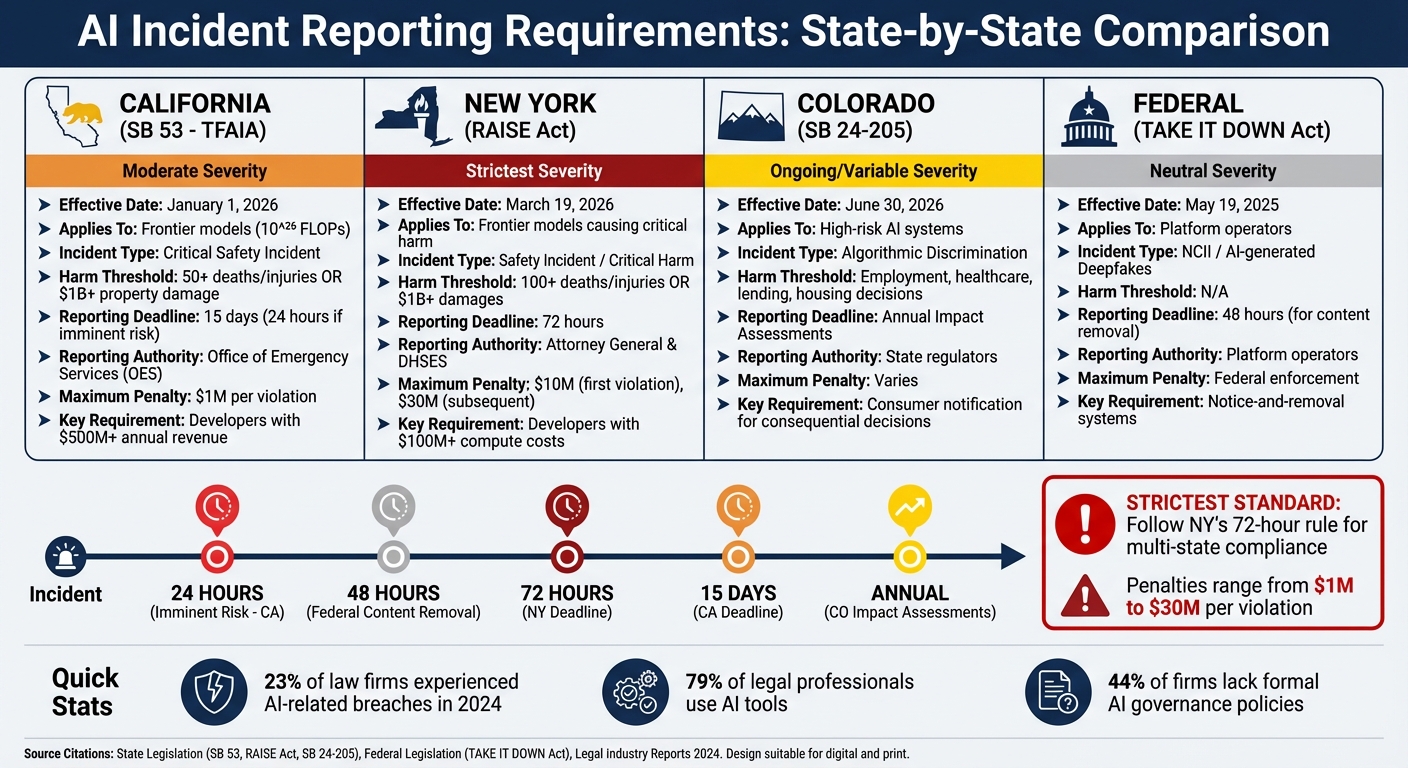
AI Incident Reporting Requirements by State: Deadlines, Penalties, and Thresholds
Law firms face a maze of reporting rules that differ depending on the jurisdiction. To stay compliant, the first step is understanding what qualifies as a reportable AI incident – and who is responsible for filing the report.
What Qualifies as a Reportable AI Incident?
The criteria for reporting depend on the type of AI system, the severity of harm, and the specific state laws where your firm operates.
California’s Transparency in Frontier Artificial Intelligence Act (SB 53), effective January 1, 2026, focuses on “frontier models” – AI systems trained with over 10^26 computational operations (FLOPs). Reportable incidents include unauthorized access to model weights that result in harm, loss of control over the model, autonomous actions without user requests, or deceptive behaviors that increase the risk of catastrophic outcomes. Catastrophic harm in California is defined as risks leading to the death or serious injury of more than 50 people or property damage exceeding $1 billion.
New York’s Responsible AI Safety and Education Act (RAISE Act), effective March 19, 2026, requires reporting when a frontier model causes or heightens the risk of critical harm. This harm is defined as the death or serious injury of at least 100 people or damages over $1 billion. The law applies to developers who have spent more than $100 million on total compute costs.
Colorado’s Artificial Intelligence Act (SB 24-205), effective June 30, 2026, targets “high-risk” AI systems used in areas like employment, healthcare, lending, and housing. It mandates annual impact assessments to identify and prevent algorithmic discrimination – outcomes that unfairly harm individuals based on protected characteristics.
For law firms, AI-generated deepfakes and non-consensual intimate imagery (NCII) present significant risks. Under the federal TAKE IT DOWN Act, signed into law on May 19, 2025, platforms are required to establish notice-and-removal systems and take down flagged AI-generated NCII within 48 hours.
Here’s a quick breakdown of the jurisdiction-specific requirements:
| Jurisdiction | Law | Incident Type | Harm Threshold | Reporting Deadline |
|---|---|---|---|---|
| California | SB 53 (TFAIA) | Critical Safety Incident | 50+ deaths/injuries or $1B+ damage | 15 days (24 hours if imminent) |
| New York | RAISE Act | Safety Incident / Critical Harm | 100+ deaths/injuries or $1B+ damage | 72 hours |
| Colorado | SB 24-205 | Algorithmic Discrimination | High-risk systems | Annual (Impact Assessments) |
| Federal | TAKE IT DOWN Act | NCII / Deepfakes | N/A | 48 hours (for removal) |
“Don’t mistake federal pullback for regulatory relief. States are stepping in – and the compliance obligations are multiplying, not simplifying.” – Parker Hancock, Senior Associate, Baker Botts
Who Must Report AI Incidents?
Once you understand what qualifies as a reportable incident, the next step is identifying who is responsible for reporting. Developers, deployers, and users all have distinct roles in this process.
Frontier developers, who train AI models using over 10^26 FLOPs, bear the primary responsibility for reporting critical safety incidents. In California, this applies to developers with annual gross revenues exceeding $500 million, with penalties for noncompliance reaching $1 million per violation. New York enforces even steeper penalties: up to $10 million for the first violation and $30 million for subsequent ones.
Deployers, or organizations that implement AI systems into their operations, must follow state-specific rules. For example, Colorado’s AI Act requires annual impact assessments and mandates that consumers be notified when high-risk AI is used in consequential decisions. Texas’s Responsible AI Governance Act (TRAIGA), effective January 1, 2026, obligates deployers to take reasonable steps to prevent algorithmic discrimination and maintain safety protocols.
Large AI development organizations must also appoint senior personnel to oversee compliance with safety and security protocols, as required by New York’s RAISE Act. California offers whistleblower protections for employees involved in risk assessments who report threats to public health or safety.
For law firms, the responsibility doesn’t stop with the vendor. As Ben Bafumi, Associate at Baker Botts, points out:
“AI use is welcome – and now almost expected – in New York courts, but it must be used competently and verifiably through diligent attorney oversight.”
This means attorneys must verify AI-generated outputs, understand the limitations of the tools they use, and report incidents when AI systems cause harm or create catastrophic risks.
To ensure compliance, start by cataloging all AI systems – including any shadow AI being used. Map out how these systems fit into the definitions of “frontier” or “high-risk” under applicable state laws. Update vendor agreements to clearly outline liability for AI-specific risks, such as autonomous errors or intellectual property infringement. Lastly, establish documented response protocols to meet the strict reporting deadlines outlined above.
sbb-itb-95f4849
Reporting Deadlines and Procedures
Timely reporting of AI incidents is critical to avoid hefty penalties. Once a reportable incident is identified, the countdown begins. Missing these deadlines can result in fines ranging from $1 million to $30 million per violation, depending on the jurisdiction.
Required Reporting Deadlines
The New York RAISE Act enforces the tightest timeline in the U.S., requiring developers to notify the State Attorney General and the Division of Homeland Security and Emergency Services (DHSES) within 72 hours of discovering a safety incident. This reflects the rapid pace of AI-related threats; for example, by 2025, the fastest 25% of cyber breaches reached data exfiltration in just 72 minutes – a dramatic drop from 285 minutes the year before.
In contrast, California’s TFAIA offers more time for most incidents, allowing developers up to 15 days to report critical safety issues to the Office of Emergency Services (OES). However, if the incident poses an immediate risk of death or serious injury, the deadline tightens to just 24 hours.
| Regulation | Reporting Deadline | Reporting Authority | Max Penalty |
|---|---|---|---|
| NY RAISE Act | 72 hours | Attorney General & DHSES | $10M–$30M per violation |
| CA SB 53 (TFAIA) | 15 days (24 hours if imminent) | Office of Emergency Services | $1M per violation |
| TAKE IT DOWN Act | 48 hours (for removal) | Platform operators | Federal enforcement |
As Kimberly Kiefer Peretti, Partner at Alston & Bird, explains:
“The reporting obligations in the RAISE Act are significantly stricter than those under California’s TFAIA, which gives AI developers 15 days to report an incident.”
For firms operating across multiple states, adhering to the 72-hour standard is the safest bet. This approach ensures compliance even when the applicable state law is unclear at the time of discovery.
With these deadlines in mind, let’s explore how to document and report AI incidents effectively using automated legal features.
How to Report an AI Incident
Meeting deadlines is only part of the equation. Proper reporting also requires thorough documentation to satisfy regulators and shield your firm from liability.
Classify the incident first. Determine whether it qualifies as a safety incident (e.g., unauthorized autonomous actions or disclosure of model weights) or a serious incident (e.g., malicious exploitation or a data breach).
Preserve evidence immediately. Traditional forensic techniques often fall short in capturing AI-specific data, such as prompt logs, model outputs, and reasoning chains. As Alston & Bird emphasizes:
“Forensic teams cannot rely on the old playbook – they likely need new methods such as monitoring AI interactions, auditing prompts, and implementing specialized AI audit trails to reconstruct the reasoning chain.”
Use standardized templates. Reports should follow established frameworks like the OECD’s 29-criteria framework or the European Commission’s draft incident reporting template. At a minimum, include:
- Date and time of incident discovery
- Nature of the incident (e.g., unauthorized access, algorithmic bias, deepfake misuse)
- Harm or potential harm (e.g., injuries, property damage, rights violations)
- AI system details (model type, deployment context, compute costs)
- Mitigation efforts (corrective actions and ongoing monitoring)
Submit to the appropriate authority. Ensure reports are filed with the correct agency: in New York, this means the Attorney General and DHSES; in California, the OES.
Keep a decision register. Record who approved the notification, when it was made, and the rationale behind it. This log serves as a defensible record for audits and demonstrates that your firm acted thoughtfully and in line with policy. Mark Sharron from ISMS.online advises:
“The clock always begins before you’re ready; waiting for certainty only loses the initiative.”
Additionally, law firms must ensure that vendors report incidents promptly and may need to submit supplemental reports to state authorities themselves.
Communicating with Clients During AI Incidents
After reporting an AI incident to the authorities, your next responsibility is addressing your clients. Clear and timely communication is essential, especially given the unique challenges AI tools can present – think algorithmic unpredictability or the risk of waiving privilege.
When and How to Notify Clients
According to ABA Formal Opinion 483, lawyers must inform current clients about a data breach if “material client confidential information is misappropriated, destroyed or otherwise compromised”. The emphasis here is on the word material. For instance, a breach involving sensitive financial records or merger plans would require disclosure, while an incident involving an old draft of a public document might not.
Timing is critical. Once you’ve assessed the breach’s scope, notify your clients promptly. Keep in mind that disclosure requirements vary by jurisdiction. Some areas mandate notification for any exposure of confidential information. If you operate across multiple jurisdictions, it’s safest to follow the strictest standard to ensure compliance.
A stark example of the consequences of delayed notification comes from the 2020 malpractice lawsuit against Warden Grier, filed by Hiscox Insurance. The firm failed to inform clients for over 16 months after a 2016 breach where the “Dark Overlord” hacker stole and leaked personal identifying information (PII). This lapse not only damaged the firm’s finances but also eroded trust and tarnished its reputation.
When notifying clients, include essential details like the discovery date, the nature of the incident, the type of information affected, and the steps being taken to resolve the issue. Given the complexities of AI-related breaches – such as prompt injections – you may also need to provide explanations of unique evidence, like prompt logs or model outputs, which traditional forensics might overlook.
Once clients are informed, it’s equally important to strike a balance between transparency and protecting confidentiality.
Managing Transparency and Confidentiality
After notifying clients, take care to ensure that the information shared does not inadvertently expose them to further risks.
To safeguard attorney-client privilege during investigations, work with third-party forensic experts under the direction of legal counsel. This approach helps keep investigative findings protected. This is particularly crucial for AI-related incidents, as traditional forensic tools may not catch nuanced threats like prompt injection attacks within an AI’s reasoning layer.
Be upfront about which AI tools you’re using. Consumer-grade AI tools, such as free ChatGPT, often lack confidentiality safeguards. These platforms may use input data for model training, potentially waiving privilege. In contrast, enterprise-grade solutions typically offer “zero data retention” policies and stronger contractual protections. A notable example is the February 2026 ruling in United States v. Heppner, where Judge Jed Rakoff determined that communications with the AI platform Claude were not protected by attorney-client privilege. The platform’s privacy policy explicitly stated that interactions were not private, underscoring the importance of using tools designed specifically for professional settings.
Here’s a quick comparison of consumer and enterprise AI tools:
| Feature | Consumer AI (e.g., Free ChatGPT) | Enterprise AI (e.g., Harvey, CoCounsel) |
|---|---|---|
| Privacy | Data often used for model training | Zero data retention policies |
| Confidentiality Protections | No contractual guarantee of privacy | Strong contractual protections |
| Privilege Risk | High risk of waiver | Designed to maintain privilege |
To further reduce risks, anonymize inputs whenever possible. Reframe or summarize queries in a way that omits client-specific details, minimizing exposure even if the AI provider suffers a breach or uses data for training purposes.
Additionally, update engagement letters to include disclosures about AI usage, potential risks (like “hallucinations”), and data security considerations. This proactive step demonstrates your commitment to keeping clients informed. The Texas Bar Practice AI Toolkit puts it well:
“AI is a tool to assist our attorneys; it does not replace the judgment and expertise of your legal team”.
Reducing Risks and Maintaining Compliance
With AI becoming a core part of legal workflows, managing risks and ensuring compliance is no longer optional. In fact, 20% of U.S. law firms reported experiencing a cyberattack in 2024, underscoring the importance of proactive strategies. A solid risk management framework can help mitigate these challenges while maintaining compliance.
Setting Up Risk Management Systems
Start by forming an AI governance committee. This group, including members from IT, security, legal, and compliance teams, centralizes oversight and keeps a record of all AI-related decisions.
Next, implement a tiered risk model to classify AI usage across your firm. For example:
- Prohibited: Tasks like drafting privileged strategies without explicit approval.
- Restricted: Activities such as legal research requiring dual-lawyer review and source verification.
- Standard: Internal summaries subject to mandatory attorney validation.
This system ensures that every AI task is subject to the appropriate level of oversight, creating a compliance-first culture.
A human-in-the-loop (HITL) protocol is another critical safeguard. Attorneys should independently verify all AI-generated citations, quotes, and legal arguments against primary sources before submitting them to courts or clients. As Jon Dykstra of Jurvantis.ai explains:
“Responsibility stays with the lawyer, and controls have to live in workflow, tool settings, and review steps that hold under deadline pressure”.
To get started, consider a 30-day plan:
- Week 1: Publish a list of approved tools and block unapproved public AI tools for client matters.
- Week 2: Train staff on secure prompting practices and introduce vetted alternatives.
- Week 3: Enforce citation verification for court submissions.
- Week 4: Align retention settings and define an AI-incident escalation process.
Additionally, schedule quarterly reviews of AI outputs and compliance measures. These reviews can help your firm adapt to changes in state bar opinions and privacy laws. Regular audits of AI inputs can also identify and block harmful instructions before they cause issues.
Integrating these controls into daily workflows ensures that compliance becomes second nature.
Using Practice Management Software for Compliance
Practice management software simplifies compliance efforts by automating key processes. For example, it can create audit trails that record AI use, including timestamps and reasoning logs. These logs provide evidence of due diligence, which is crucial if regulators or courts later question your work. This is particularly important as 79% of legal professionals report using AI tools, yet 44% of firms still lack formal AI governance policies.
Such software also addresses billing compliance. According to ABA Formal Opinion 512, lawyers billing hourly can only charge for their actual time – not for work done solely by AI. Practice management tools can track the time spent on prompting, reviewing, and refining AI output to ensure accurate billing.
For firms handling sensitive health data, these tools enforce data isolation and access controls to comply with HIPAA regulations. With penalties ranging from $100 to $50,000 per violation and an annual cap of $1.5 million, compliance is critical. The right software ensures client information isn’t used to train public AI models and restricts access to protected health information.
Platforms like The Legal Assistant offer features like document generation, task management, and intelligent automation to centralize compliance efforts. By integrating mail/email management, billing, and event tracking into one system, firms can uniformly apply AI governance policies. Its cloud hosting and specialized modules for personal injury and real estate law make it particularly effective for managing sensitive client data while maintaining efficiency.
Conclusion
AI is transforming the legal field, bringing both opportunities and critical responsibilities. While nearly 80% of U.S. lawyers now use AI, a surprising 44% of firms lack formal governance structures, leaving them vulnerable to significant risks.
This fast-paced shift underscores the importance of implementing strong compliance measures.
“The easiest way to ensure compliance is to leverage purpose-built, legal-specific AI tools designed carefully to minimize risks and support ethical obligations”.
Understanding and adhering to reporting requirements is non-negotiable. States like California, Colorado, and Utah enforce strict deadlines – sometimes as short as 24 hours – and impose penalties that can reach $1 million per violation.
To stay compliant, integrate these obligations into your daily operations. Revise incident response plans to address AI-related risks, verify AI-generated citations using reliable sources, and train your team on secure prompting practices. Maintaining comprehensive audit trails is another essential step to protect both your clients and your firm.
Technology offers valuable support in managing compliance. Legal-specific practice management software can centralize audit trails, automate compliance tasks, and safeguard your operations. For example, platforms like The Legal Assistant streamline processes by combining document generation, task tracking, and billing in one system. This makes it easier to uniformly apply AI policies while meeting the security expectations of your clients.
Start by taking stock of your current AI tools, enforcing verification protocols, and choosing solutions that align with your compliance requirements. These steps will help you navigate the evolving legal landscape with confidence.
FAQs
Does my law firm have to report an AI incident, or does the vendor?
Your law firm usually takes charge of reporting an AI-related incident. That said, vendors might also share this responsibility, particularly if the problem stems from their AI systems or faulty products. It’s important to assess the situation carefully to figure out who is accountable for reporting.
What’s the fastest deadline I might face after discovering an AI incident?
The quickest response window is usually within the first 24 hours. This period is critical for thoroughly documenting the incident and initiating steps to reduce potential damage. Acting swiftly not only helps meet legal requirements but also plays a key role in managing risks efficiently.
How do I notify clients without waiving attorney-client privilege?
To communicate with clients while maintaining attorney-client privilege, avoid disclosing sensitive or privileged details on public AI platforms or unsecured channels. Instead, rely on secure and private communication methods, ensuring these discussions occur under attorney supervision. This approach safeguards confidentiality and helps prevent unintentional waivers of privileged information.